

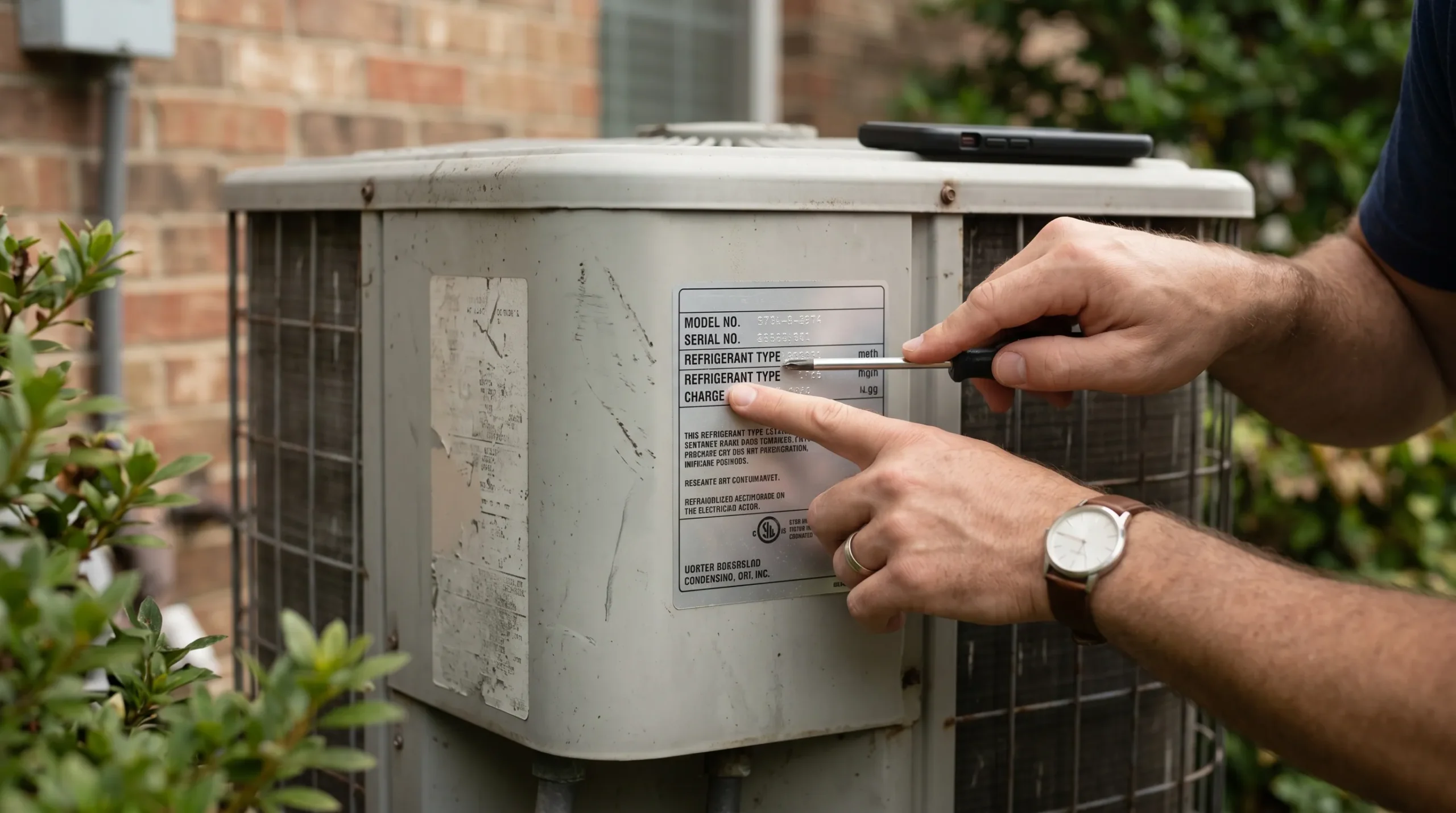
How to determine what refrigerant is in AC is one of the most important things to figure out before you schedule a repair, ask for a recharge, or decide whether it is time for a replacement. The refrigerant type on AC unit affects service availability, compatibility, cost, and sometimes even whether a newer refrigerant can be used at all. The U.S. EPA says the refrigerant used in a home air conditioner is typically listed on the unit’s nameplate, and if the nameplate is missing, you should check the owner’s manual, contact the company that sold or services the unit, or use the manufacturer and model number to confirm it.
Today, this question matters even more because homeowners may be dealing with R-22, R-410A, or newer options like R-454B and R-32. The U.S. Department of Energy says that today’s systems use HFCs and the latest low-carbon A2L refrigerants, which means refrigerant identification is no longer just a maintenance detail. It is part of understanding what your system can safely use and what your next move should be.
Why refrigerant type matters before you schedule repair, recharge, or replacement
Your AC refrigerant is not just a technical label. It affects whether your unit can still be serviced affordably, whether parts and refrigerant are easier to source, and whether a technician may recommend repair, leak repair, recharge, or full system replacement. If your unit uses R-22 refrigerant, for example, that is a very different situation from a system using R-410A or a newer low-GWP refrigerant like R-454B. The EPA notes that R-22 is no longer produced or imported for U.S. use, and homeowners with older systems often need to think more carefully about cost and long-term serviceability.
That is why this topic has both informational and commercial value. A homeowner may start by searching what refrigerant does my air conditioner use, but what they really want to know is this: Can I still fix it? Will a recharge make sense? Will I be forced into a replacement? The answer often starts with the refrigerant itself.
Here is the simple rule: identify the refrigerant first, then make the repair or replacement decision second.
The safest ways to determine what refrigerant is in your AC
1. Check the equipment nameplate or manufacturer label on the outdoor unit
This is the best starting point and the most reliable homeowner-friendly method. According to the EPA, the refrigerant is typically listed on the unit’s nameplate. On most central systems, that means the outdoor condenser or outdoor condensing unit. Look for a metal or printed manufacturer sticker, equipment nameplate, or rating plate that lists details such as the model number, serial number, and factory charge.
Common labels may include wording like:
- Refrigerant: R-22
- Refrigerant: R-410A
- Factory Charge: R-454B
- Use only refrigerant listed on nameplate
Do not overcomplicate this step. In many cases, the answer is already on the unit. If the manufacturer label on outdoor unit is readable, you may not need anything else.
2. Use the system age as a clue, not as your only proof
The age of the system can help narrow things down, but it should never be your only evidence. In general, older residential systems are more likely to use R-22, while many units installed after the R-22 transition moved to R-410A. Newer units entering the market are increasingly using R-454B, R-32, and other A2L refrigerants. The DOE says that today’s and future systems include A2L refrigerants, which are part of the current shift toward lower climate impact options.
A practical rule of thumb looks like this:
| System age | Likely refrigerant clue | What it means |
|---|---|---|
| Older system, often before 2010 | Often R-22 | Service may be more expensive |
| Many systems from the 2010s | Often R-410A | Still common in existing systems |
| Newest transition-era systems | Often R-454B or R-32 | Part of lower-GWP shift |
This is useful for queries like how to know if your AC uses R-22 or R-410A, but you should still confirm by label, manual, or manufacturer lookup.
3. Check service records, invoices, and old technician stickers
If the label is missing, your next-best option is paperwork. The EPA explicitly advises homeowners to check the owner’s manual or contact the company that sold or services the system. Old service invoices often mention the refrigerant used during a repair, leak test, or maintenance visit.
Look through:
- past service records
- maintenance invoices
- warranty documents
- install paperwork
- stickers placed inside the service panel
This step works especially well if you are asking how to check old HVAC service records for refrigerant or what type of refrigerant does my AC system use after buying a home.
4. Look up the model number on the manufacturer website
If you can find the model number and serial number, the EPA says you can use the manufacturer and model number to verify the refrigerant, either by calling the manufacturer or checking its website.
This is one of the best answers to how to search HVAC model number for refrigerant type and how to identify refrigerant from model number.
A simple process looks like this:
- Find the model number on the outdoor unit nameplate.
- Search the manufacturer’s official website for the product page or PDF manual.
- Check the specifications, installation manual, or owner’s manual.
- Confirm the listed refrigerant and factory charge.
This method is especially helpful when the label is faded or partially unreadable.
5. Call a licensed HVAC technician when the answer is still unclear
There is nothing wrong with stopping here and asking a professional. A licensed HVAC technician can confirm the refrigerant type safely and tell you whether your unit is a good candidate for repair, recharge, or replacement.
That is the right move if:
- the nameplate is gone
- the model number is unreadable
- the system has had partial equipment replacement
- you suspect a refrigerant leak
- you are worried someone may have used the wrong refrigerant before
Quick refrigerant guide: what R-22, R-410A, R-454B, and R-32 usually mean
Understanding the label helps you make sense of your options.
R-22
R-22 was widely used in older systems, but the EPA says it is no longer produced or imported for use in the United States. Existing systems can still sometimes be serviced, but homeowners often face higher costs and more limited supply.
If your label says R-22, your next questions are usually:
- Is R-22 still available?
- What to do if your air conditioner needs R-22
- When to replace an R-22 air conditioner
R-410A
R-410A became the common replacement for many residential systems after the R-22 phase-out. It is still found in many installed systems today, so seeing R-410A on your unit is normal. The important thing is that your existing system still uses what it was designed for.
R-454B
R-454B is one of the newer lower-GWP refrigerants appearing in residential equipment. It is part of the transition away from higher-GWP options in newly manufactured systems.
R-32
R-32 is another refrigerant tied to the newer generation of lower-GWP systems. It is part of the same broader shift homeowners are hearing about in the refrigerant transition.
What if the label is missing, faded, or unreadable?
This is one of the biggest real-world pain points, and it is exactly why so many homeowners search how do I know what refrigerant is in my AC.
If your unit nameplate is unreadable, do this in order:
First, check the owner’s manual. The EPA specifically recommends it. Second, use the model number and manufacturer website. Third, contact the contractor or company that sold or serviced the system. Fourth, ask a technician to confirm it professionally.
What you should not do is guess based on hearsay, assume by the house age alone, or rely on old refrigerant-color myths. AHRI says container colors should not be relied upon exclusively to determine the type of refrigerant, and AHRI later moved the industry toward a more uniform container color approach to reduce confusion.
That makes why you should not identify refrigerant by cylinder color a very important modern rule.
Why you should not guess, mix refrigerants, or rely on refrigerant color alone
This is where many costly mistakes happen.
Different refrigerants are not simply interchangeable versions of the same thing. Systems are designed around specific refrigerants, pressure characteristics, and oil compatibility. If you are asking can you retrofit R-410A to R-454B or can I use a newer refrigerant in an older system, the answer is usually not something you should decide on your own. Compatibility is an equipment-design issue, not a guess.
AHRI warns against depending on color alone for identification, and the whole reason for its guidance is to avoid confusion and misidentification.
A good rule to remember is this quote-worthy takeaway:
Do not mix refrigerants, and do not assume two systems can use the same refrigerant just because they are both air conditioners.
That principle protects your compressor, evaporator coils, condenser coils, and overall system life.
What current refrigerant rules mean for homeowners
The current refrigerant transition can sound more confusing than it needs to be. Here is the plain-English version.
The DOE says current and future refrigerants include HFCs and the latest low-carbon A2L refrigerants. The EPA homeowner guidance still points people back to the unit nameplate, manual, and manufacturer for accurate identification.
The practical meaning for homeowners is simple:
- your existing system should use the refrigerant it was designed for
- newer equipment is moving toward lower climate-impact refrigerants
- A2L refrigerants are part of that shift
- none of this means you must instantly replace a working unit just because refrigerant rules have evolved
A widely shared builder-industry summary of EPA regulations also notes that 2026 installation restrictions remain in effect for new AC and heat pump systems under EPA rules issued under the American Innovation and Manufacturing Act.
So if your current system uses R-410A, that does not automatically mean it is unusable. It means you should identify it correctly, service it properly, and plan intelligently for the future.
Does your AC need a recharge, a leak repair, or full replacement?
This is the section many readers really came for.
A healthy residential AC is a closed-loop system. That means refrigerant is not something that normally “gets used up” like fuel. If the level is low, that usually points to a refrigerant leak rather than a routine top-off situation. That is why searchers asking does AC refrigerant need to be refilled are often really dealing with a leak diagnosis. The EPA also warns homeowners against purchasing or using unapproved or misleading refrigerant substitutes such as products falsely marketed as R-22 replacements.
Signs the problem may be a leak
Common warning signs include:
- reduced cooling
- short cycling
- ice on evaporator coil
- hissing noises
- bubbling noises
- poor airflow combined with weak cooling
These signs do not confirm the refrigerant type, but they do suggest the system needs professional attention.
When recharge makes sense
A recharge may make sense when:
- the refrigerant type is known
- the leak has been found and repaired
- the system is otherwise in good condition
- the cost is reasonable compared with the age of the system
When replacement is smarter
Replacement starts to make more sense when:
- the unit uses R-22
- leak repairs are recurring
- the system is old and inefficient
- parts are hard to get
- repair cost is approaching the value of a new system
This is also where efficiency, reliability, and long-term cooling costs matter more than one cheap short-term repair.
A simple homeowner case study
A homeowner buys a house with an older central A/C system and notices the AC unit label is faded. They search how to determine what refrigerant is in ac and assume the answer must require gauges or opening the system.
It does not.
They check the outdoor nameplate and find the model number but no clear refrigerant line. They search the model number on the manufacturer’s website, pull up the archived specifications, and confirm the unit uses R-410A. Now they know two important things: the system is not an old R-22 unit, and any service quote should match R-410A equipment requirements. They avoid guessing, avoid a misinformed upsell, and make a much better repair decision.
That is exactly why identification comes first.
FAQ: common questions about figuring out what refrigerant is in an AC
How do I know if my AC uses R-22 or R-410A?
Start with the unit nameplate on the outdoor condenser. If that is missing, check the owner’s manual, service records, or manufacturer website using the model number. The EPA specifically recommends those methods.
Can I tell refrigerant type from the model number?
Often, yes. The EPA says if you know the manufacturer and model number, you can check the manufacturer website or contact the manufacturer directly.
Can I identify refrigerant by color?
No. AHRI says colors should not be relied upon exclusively to identify refrigerant containers, and the industry moved away from the old color-assignment system to reduce confusion.
Do new AC units still use R-410A?
The market is shifting toward lower-GWP refrigerants such as R-454B and R-32, and DOE says the latest systems include A2L refrigerants.
Should I check refrigerant myself or call a pro?
Check the label, manual, model number, and paperwork yourself. Call a pro if the answer is still unclear, if the system may have a leak, or if you are tempted to open the sealed system.
Final takeaway
The smartest way to answer what refrigerant does my HVAC system use is also the simplest: check the equipment nameplate, confirm with the model number or owner’s manual, and get a licensed HVAC technician involved if the answer is still not clear. The EPA’s guidance makes that process straightforward, and modern refrigerant changes make it more important than ever to identify the refrigerant correctly before making repair decisions.
Disclaimer:
This article is for general informational purposes only and is not a substitute for advice from a licensed HVAC professional. Refrigerant types, AC systems, repair needs, costs, and local regulations can vary by unit, location, and situation. Always confirm your system details with the manufacturer, service records, or a qualified HVAC technician before making repair, recharge, or replacement decisions.