

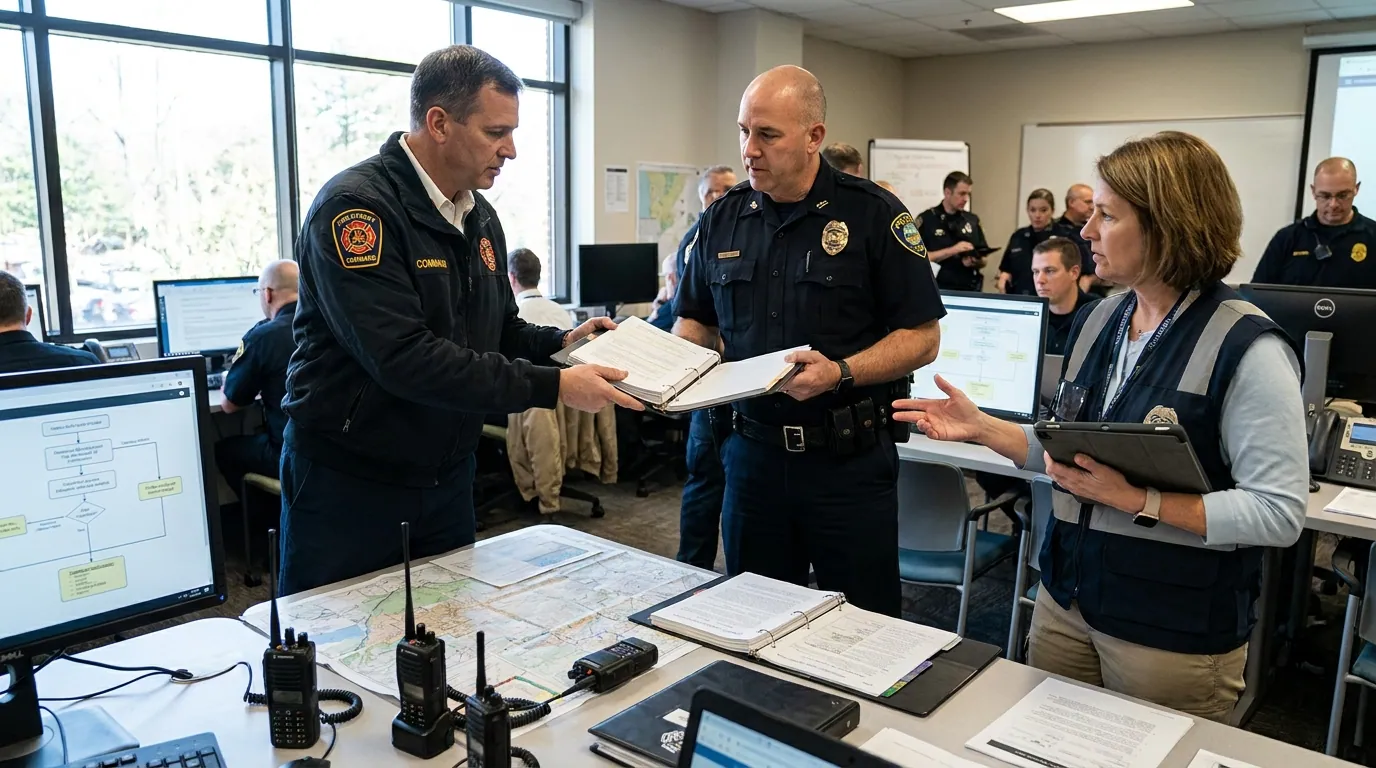
Who designates the process for transferring command is a common FEMA/ICS question, and the correct answer is the jurisdiction or organization with primary responsibility for the incident. In official ICS guidance, that authority designates the individual at the scene responsible for establishing command and the protocol for transferring command. When command transfers, the process includes a briefing that captures essential information so operations continue safely and effectively.
That short answer is what many people need for FEMA IS-100.C, ICS 200, or related training. But if you want to actually understand the topic—and write a page that can outrank thin quiz-answer sites—you need more than one sentence. You need to explain what transfer of command means, who establishes command, when command should change hands, and what information must be passed to the incoming Incident Commander. FEMA’s training materials and forms give you that extra depth, while most competing pages stop at the answer itself.
The Direct Answer in Plain English
In simple terms, the jurisdiction or organization with primary responsibility for the incident is the body that decides who is in charge and how that handoff happens if command needs to change. That could be the agency with legal authority over the incident, the organization responsible for the response, or the jurisdiction where the incident occurs. The key point is that transfer of command is not supposed to be informal, random, or based on who speaks loudest. It is meant to follow an established incident command structure with clear authority, responsibility, and accountability.
This matters because incident management can become chaotic very quickly. If responders are unsure who has command, or if a change in leadership is not communicated clearly, the result can be duplicated work, missed priorities, confusion about resource assignments, and safety risks at the incident scene. That is why ICS emphasizes clear lines of authority, common terminology, and an orderly process for leadership transitions.
What Transfer of Command Means in ICS
In ICS, transfer of command means the movement of incident command responsibility from one Incident Commander to another. It is part of the broader Establishment and Transfer of Command concept. FEMA’s guidance explains that command should be clearly established at the beginning of an incident, and when command transfers, the process should include a briefing that captures the critical facts needed for ongoing operations.
That definition is important because many searchers mix up transfer of command, delegation of authority, and Unified Command. They are related, but they are not the same thing. Transfer of command is about one Incident Commander handing command responsibility to another. It is a structured leadership change inside the incident management system. A good article should explain that difference clearly, because users often search this keyword as a one-line question but really need the surrounding context to understand it fully.
Who Establishes Command at the Beginning of an Incident?
The same authority behind this keyword also answers a closely related question: who establishes command at the start of an incident? FEMA’s review material states that the jurisdiction or organization with primary responsibility for the incident designates the person at the scene responsible for establishing command. In practice, that means the authority with primary responsibility determines who the initial Incident Commander will be.
This is why the keyword is often presented in quiz form. The official wording ties together two ideas: establishing command and the protocol for transferring command. If a page only gives the answer without explaining that relationship, it misses a major part of the user’s intent. Searchers are often trying to confirm not just the answer choice, but also the logic behind it. A stronger article makes that connection obvious.
When Should Command Be Transferred?
Command may transfer for several reasons. The incident may grow in size or complexity. A more appropriate or more experienced Incident Commander may need to assume responsibility. Jurisdictional responsibility may shift. The response may move into a new operational period. Or a different agency may become the lead organization as the situation develops. FEMA’s ICS materials frame command transfer as a normal part of incident management when done in an orderly way.
At the same time, a more qualified person does not automatically mean command must change immediately. Good command transfer is about continuity, not ego. The purpose is to maintain safe and effective operations with minimal disruption. That means agencies should rely on existing policies and procedures, organizational guidelines, and incident needs—not confusion or status competition—when deciding whether to transfer command. This is one of the most useful clarifications because thin competitor pages rarely explain the practical “when” behind the answer.
What a Transfer-of-Command Briefing Should Include
One of the biggest content gaps in the current SERP is the briefing itself. FEMA says that when command transfers, the process includes a briefing that captures essential information needed for the incident to continue safely and effectively. That means the outgoing and incoming command structure should exchange the facts that matter most right now—not vague summaries, but operational details that support immediate decision-making.
A practical transfer-of-command briefing should cover the following points:
| Briefing element | Why it matters |
| Incident history | Gives the incoming leader fast context |
| Current situation | Explains what is happening now |
| Priorities and objectives | Shows what the response is trying to achieve |
| Current organization | Clarifies who is in which role |
| Resource assignments | Shows what personnel and assets are committed |
| Safety concerns | Highlights hazards and protective measures |
| Current and planned actions | Keeps momentum during the handoff |
| Effective time/date of transfer | Removes ambiguity about when authority changed |
The exact format may vary, but FEMA’s ICS Form 201 and related ICS forms support this structure. FEMA’s forms booklet specifically points to Situation Summary and Health and Safety Briefing information for briefings or transfer of command, and the form descriptions emphasize that ICS Form 201 gives the Incident Commander and Command/General Staff basic information about the incident situation and allocated resources.
This is where your article can be better than the average answer page. Instead of stopping at “the jurisdiction or organization with primary responsibility,” you can explain how the process actually works. That makes the content more useful for trainees, responders, and anyone trying to understand incident briefing, resource ownership, incident objectives, and the real mechanics of command transfer.
The Role of ICS Form 201 in Command Transfer
ICS Form 201, also called Incident Briefing, is one of the most useful documents to mention in this topic. FEMA says the form provides the Incident Commander and the Command and General Staffs with basic information about the incident and the resources allocated to it. It also serves as an initial action worksheet and a permanent record of the initial response. Most importantly for this keyword, FEMA says the form is prepared by the Incident Commander for presentation to the incoming Incident Commander along with a more detailed oral briefing.
That makes ICS Form 201 highly relevant to any article targeting who designates the process for transferring command. It connects the answer to real documentation, not just abstract theory. A quality page can mention that the handoff should not rely on memory alone. Written incident briefing materials help preserve continuity, communicate hazards, confirm current organization, and document resource assignments. This is exactly the kind of practical detail that improves topical authority.
Transfer of Command vs. Delegation of Authority vs. Unified Command
These terms often get blended together, but they refer to different parts of the response system. Transfer of command is the handoff of incident command responsibility from one Incident Commander to another. Delegation of authority is the formal granting of authority by the Authority Having Jurisdiction or agency leadership, often through policy or incident-specific direction. FEMA’s senior-officials overview explains that delegation of authority is normally established through policy before the incident, though overlapping jurisdictions may require a separate incident-specific delegation.
Unified Command is different again. Under Unified Command, leaders from more than one responsible jurisdiction or agency work together through a single, coordinated structure. The National Response Framework describes the use of NIMS and standardized command structures for incident management, while FEMA’s materials connect Unified Command to the command function at the beginning of an incident. In other words, Unified Command is not the same as a simple one-person handoff. It is a shared command arrangement for incidents involving multiple authorities.
A strong SEO article should explain these differences because they support major LSI keywords such as unity of command, delegation of authority, joint decision making, and consolidated Incident Action Plan. Competitors rarely do this well, which leaves room for content that is more helpful and more complete.
Why This Question Shows Up in FEMA IS-100.C and ICS Training
The phrase sounds like a test question because it often is one. FEMA’s IS-100.C course introduces the Incident Command System and explains its history, features, principles, and organizational structure. IS-200.C builds on that foundation for personnel likely to assume supervisory positions within ICS. FEMA’s training materials also describe a model NIMS ICS curriculum that includes IS-100.c, IS-200.c, and higher-level courses such as ICS 300.
That training context explains the search behavior around this keyword. Many people are not looking for a general essay on leadership. They want the official FEMA answer, but they also want confidence that they understand it correctly. That is why the best article tone is simple and direct: give the answer right away, then explain the incident command structure, the formal process of transferring command, and the briefing requirements in everyday language.
A Short Scenario Example
Imagine a fast-moving wildfire response. The local fire agency is the jurisdiction with primary responsibility during the initial attack, so it designates the person at the scene responsible for establishing command. As the incident expands across jurisdictional boundaries and additional agencies arrive, command may need to transfer to a more appropriate Incident Commander or shift into Unified Command. During that transfer, the incoming command staff needs a clear briefing on the incident’s history, current hazards, objectives, organization, and resource status.
This scenario shows why the answer is not just a memorization item. The goal is continuity. Without a structured transfer, responders can lose time, duplicate actions, or miss major safety threats. With a formal transfer of command, supported by briefing documents like ICS Form 201, the organization preserves clarity and keeps operations moving with less disruption.
Common Mistakes and Misconceptions
One common mistake is assuming the Incident Commander personally decides the overall rules for command transfer without reference to the responsible jurisdiction or organization. Official ICS language points higher: the jurisdiction or organization with primary responsibility for the incident designates the person responsible for establishing command and the protocol for transferring it. That wording matters.
Another mistake is thinking a command transfer is just a quick verbal note. FEMA’s materials make clear that the process includes a briefing with essential information for safe and effective operations. A third mistake is confusing transfer of command with delegation of authority or Unified Command. They work together inside the same system, but they solve different problems. A fourth mistake is ignoring documentation. In real incident management, written forms and structured briefings reduce ambiguity and help protect continuity, accountability, and safety.
Quick Answer Summary
If you need the answer fast, here it is again: the jurisdiction or organization with primary responsibility for the incident designates the process for transferring command. In ICS, that same authority designates the individual responsible for establishing command, and when command transfers, the process includes a briefing with the essential information needed to continue operations safely and effectively.
If you want your article to rank better than the thin competitor pages, do not stop at the answer. Explain what transfer of command is, when it happens, how the briefing works, and why ICS Form 201 matters. That combination matches the real user intent behind the search and builds stronger topical authority around FEMA, ICS, NIMS, Incident Commander, incident briefing, delegation of authority, and Unified Command.
Disclaimer: This article is for general informational and educational purposes only and is not official FEMA, NIMS, or legal guidance. ICS procedures, command structures, and transfer-of-command protocols may vary depending on the incident, jurisdiction, agency policies, and operational requirements. Always follow the latest official FEMA training materials and local emergency management procedures.