

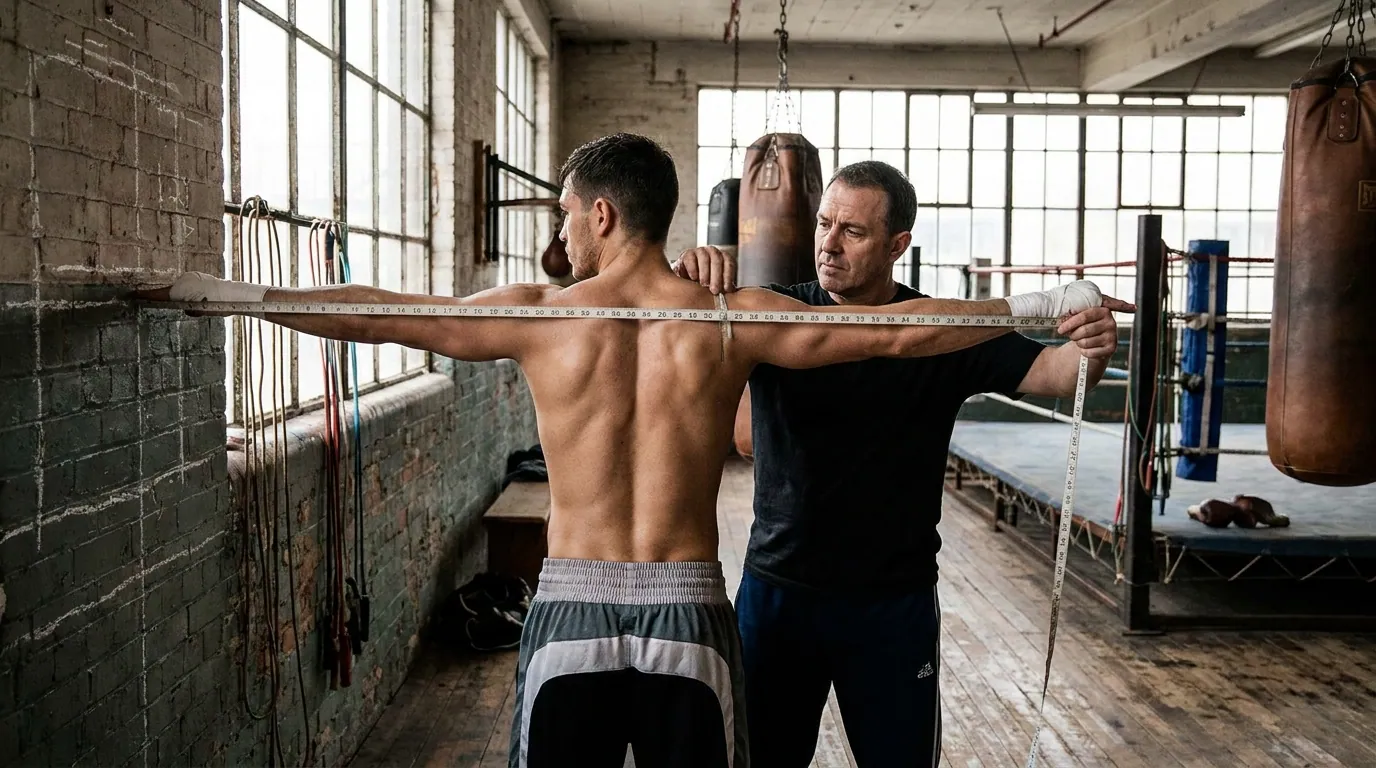
How do you measure boxers reach? In boxing, a fighter’s reach is usually measured from fingertip to fingertip with both arms stretched out straight at shoulder height, much like a wingspan measurement. That is the standard number most people see on a tale of the tape, in gym notes, and in fight analysis. But there is more to it than just reading a tape measure. To understand boxing reach properly, you also need to know how it differs from arm length, how it affects range management, and why a longer reach does not automatically make someone the better fighter.
If you have ever wondered whether reach is the same as wingspan, whether you can measure it by yourself, or whether a 7 inch reach advantage really means a fighter can punch 7 inches farther, this guide will clear it up. By the end, you will know how to measure a boxer’s reach, how to read the number correctly, and how to use that information in real training and fight strategy.
What Is Reach in Boxing?
In simple terms, reach in boxing is the distance from the tip of one middle finger to the tip of the other when both arms are extended sideways in a straight line. In most cases, this is basically the same thing as a person’s wingspan or arm span. That is why many people ask, is reach the same as wingspan? In official boxing usage, the answer is usually yes.
This is where beginners often get confused. They hear a commentator say a fighter has a 74 inch reach or a 78-inch reach, and they assume that means one punch can travel that whole distance. It does not. The listed reach is a full span measurement, not the exact distance of a single jab from the body’s centerline. Actual punching distance depends on more than the tape measure. It also depends on stance, shoulder width, chest width, posture, timing, footwork, and how a fighter rotates through the shot.
So when people compare reach vs arm length, they are talking about two different things. Reach is the full side-to-side measurement. Arm length is usually a one-arm measurement, such as shoulder to fist or armpit to fist. Both matter, but they are not interchangeable.
How Do You Measure a Boxer’s Reach Step by Step?
If you want to know how to measure reach in boxing accurately, the standard method is straightforward. You do not need special equipment. A tape measure, a flat wall, and ideally a helper are enough.
First, stand with your back against a flat surface. Keep your body upright and your shoulders level. Then raise both arms out to the sides until they form a straight line at shoulder height, almost like a T-position. Your arms should be fully extended but not strained, and your elbows should stay straight. Spread your fingers naturally without stretching them too hard.
Now measure from fingertip to fingertip. Most people use the tip of the middle finger on each hand. That number is your boxing reach. Record it in inches if you want it in the format commonly used in boxing media, and in centimeters if you want a metric reference for training notes.
If another person is helping, the process is easier and usually more accurate. One person keeps the tape straight while the other stays still. That reduces the chance of twisting the torso or lifting one shoulder higher than the other.
A quick version of the process looks like this:
| Step | What to Do | Why It Matters |
|---|---|---|
| 1 | Stand straight against a wall | Keeps posture consistent |
| 2 | Extend both arms horizontally | Creates the standard wingspan measurement |
| 3 | Keep elbows straight and shoulders level | Prevents false extra length |
| 4 | Measure fingertip to fingertip | Matches common official stats |
| 5 | Record in inches and cm | Useful for gyms, coaches, and comparisons |
This is the best answer to how do you measure a boxer’s reach step by step because it matches the standard way the number is reported.
Can You Measure Boxing Reach by Yourself?
Yes, how to measure boxing reach by yourself is possible, and a lot of people do it at home. It is not always as accurate as having a helper, but it can still work well if you are careful.
The simplest solo method is the wall mark approach. Stand against a wall, stretch your arms out at shoulder height, and lightly mark where each fingertip reaches. Then lower your arms and use a tape measure to measure the distance between the two marks. This is one of the best ways to measure reach without help because you can focus on posture first and measure afterward.
The biggest challenge with solo measurement is accuracy. People often lean, shrug a shoulder, bend an elbow, or rotate slightly without realizing it. Even a small change in posture can affect the final number. To improve accuracy, repeat the process two or three times and use the average if the numbers vary a little.
So if you are asking for the best way to measure boxer reach at home, the answer is simple: use the wall method, keep your body square, and repeat the measurement at least once.
Is a Boxer’s Reach the Same as Wingspan or Arm Length?
This is one of the most important sections in the whole topic because it solves a major user pain point. Reach vs wingspan vs arm length sounds similar, but they are not all identical.
In standard boxing language, reach is usually the same as wingspan. Both refer to the full distance from one fingertip to the other with arms extended. That is why when fans ask, does reach equal wingspan in boxing, the usual answer is yes.
But arm length is different. Arm length is usually a one-sided measurement, such as shoulder to fist or armpit to fist. Some people argue that this is more useful because it feels closer to actual punching range. That idea makes sense at first, but boxing does not typically list reach that way. The sport uses the broader, standardized wingspan method because it is simple and consistent for comparisons.
Even then, a listed reach does not tell the whole story. Two fighters can have the same official reach but very different live range because of stance, centerline alignment, shoulder width, flexibility, and technique. That is why a boxer with a slightly shorter listed reach can still jab effectively and control the fight.
So the clean answer is this: reach is generally your reported wingspan, arm length is a one-arm body measurement, and real fight range is a combination of body mechanics and skill.
Why Reach Matters in Boxing
A lot of people search why is reach important in boxing, and the reason is easy to understand. Reach advantage in boxing can shape how a fight is fought, especially when it comes to distance control, striking range, and the jab.
A fighter with longer reach often has an easier time landing from the outside. They may be able to establish the jab earlier, keep opponents at the end of the punch, and force shorter fighters to work harder just to get into range. That can help them control the fight, set the tempo, and score without taking as much damage.
But reach is not magic. A long reach only becomes valuable when the fighter knows how to use it. That means good footwork, smart angles, and awareness of range management. A boxer who has long arms but poor timing can still be crowded and neutralized on the inside. In the same way, a shorter fighter with sharp head movement, pressure, and explosive entries can erase a reach gap quickly.
That is why punching power, boxing IQ, and fight IQ still matter just as much. Reach helps create opportunities, but it does not guarantee success.
Reach Advantage Explained: Does a 7-Inch Reach Advantage Really Mean 7 Inches?
This is one of the most misunderstood parts of boxing discussion. If one fighter has a 7 inch reach advantage, many fans assume that means each arm reaches 7 inches farther. That is not how the number works.
The official difference is based on total fingertip to fingertip measurement. So if Fighter A has a 78-inch reach and Fighter B has a 71-inch reach, the listed difference is 7 inches. But in practical terms, that does not mean one single jab is always exactly seven inches farther. The real per-side extension may feel closer to something like 3.5 inch advantage, and even that is an oversimplification because a fight is not fought in a fixed pose.
Real punching range depends on stance, shoulder positioning, torso rotation, step length, and how the fighter uses the lead hand. A taller boxer may have a nice long jab, but if the shorter opponent times the entry well, slips outside, or attacks the body, the reach gap becomes much less important.
This is why how tale of the tape measures reach and how reach functions in live exchanges are not the same thing. One is a standardized stat. The other is a tactical reality.
Reach vs Height: Is Your Reach Supposed to Match Your Height?
Another common question is is your reach the same as your height? For many people, they are fairly close, but not always identical. Some have a neutral reach, meaning their height and wingspan are about the same. Others have a positive difference, where the arms are longer than the height. In sports, this is sometimes called an ape index.
A positive ape index in boxing can be useful because it gives a fighter longer natural extension for their size. If a boxer is 6’2″ with a reach that is a couple of inches longer than height, that can help them work at range. On the other hand, someone can be tall without unusually long arms, or shorter with a surprisingly long span.
You may see rough ideas like +5 cm / +2 in or more being described as noticeably long, while −5 cm / −2 in or more may suggest a shorter reach relative to height. These are not hard boxing rules, but they are useful ways to think about wingspan to height ratio in boxing.
This is also why readers search for average reach in boxing by height. They want a benchmark. While there is no single universal chart that decides success, comparing height and reach can help you understand whether a boxer’s build is likely to favor outside fighting or require more work inside.
Long Reach vs Short Reach: Advantages, Disadvantages, and Style Adjustments
The debate around long reach and short reach is really about style. A longer-reach fighter often does best when using outside fighting, straight punches, and measured movement. They can jab, probe, and force the other boxer to cross more distance before punching. Fighters like Tyson Fury are often discussed in this kind of context because reach, height, and range management all work together.
But longer reach comes with tradeoffs. Long fighters who do not control distance well can get crowded. If they are uncomfortable in close, a pressure fighter can push them backward and make the reach less valuable.
A shorter-reach boxer usually needs stronger entries, tighter defense, and more urgency once inside. That does not make them worse. It just means their tactics differ. Mike Tyson is a classic example of how shorter fighters can overcome reach gaps with explosive movement, head movement, and powerful combinations. Joe Frazier is another example often linked to relentless pressure and inside rhythm.
This is why searches like how to make the most of short reach, strategies for long-reach fighters, and tactics for short-reach fighters all matter. A long-reach boxer should focus on jabs, straight shots, and maintaining range. A short-reach boxer should work on closing distance safely, using angles, slipping the jab, and building pressure behind footwork.
Real Boxer Reach Examples
Looking at real names makes the concept easier to understand. Here is a simple comparison table using examples commonly mentioned in boxing discussions and competitor content.
| Boxer | Approx. Height | Approx. Reach | Why It Matters |
|---|---|---|---|
| Tyson Fury | 6ft3+ / taller heavyweight frame | 85 inches | Example of elite long-range control |
| Sonny Liston | 6ft 1 | 84 inches | Famous for unusual reach for height |
| Mike Tyson | 5 foot 8 to 5’10” range often discussed | 71-inch reach | Shorter fighter who closed distance brilliantly |
| Manny Pacquiao | Smaller frame | 67 inch reach | Skill, speed, and timing can beat size disadvantages |
| Terence Crawford | Around 6’2″ often cited in discussions | 74 inch reach | Shows how reach supports versatile offense |
These examples matter because they prove that boxing reach is useful, but not final. A fighter with a shorter listed reach can still dominate if the style, timing, and game plan are right.
Historic fight references also get used for context. For example, people still talk about Sonny Liston vs. Floyd Patterson from 1962, and Mike Tyson vs. Trevor Berbick in 1986, because reach and physical dimensions are easy to compare before the bell even rings. But the actual result still comes down to how those tools are used.
Common Mistakes When Measuring Boxing Reach
A lot of people think they know how to measure reach accurately in boxing, but small mistakes can throw the number off. The most common problem is bent elbows. If the arms are not fully extended, the measurement comes out short. Another issue is lifting one shoulder or leaning sideways, which can add false length.
Some people also measure one arm only and assume that is their official boxing reach. That creates confusion because official reporting usually uses the full fingertip to fingertip span. Others mix up wingspan and practical fight range, which are related but not identical.
Here is a quick list of common reach measurement errors:
- Bending the elbows
- Shrugging the shoulders
- Twisting the torso
- Measuring one arm instead of full span
- Using sloppy posture
- Not repeating the measurement for accuracy
A clean reach measurement checklist helps avoid all of these.
How Coaches, Gyms, and Tale-of-the-Tape Stats Record Reach
When coaches and gyms record boxing body measurements, they usually want consistency more than perfection. That is why they often use the standard wingspan method. It is quick, repeatable, and easy to compare over time.
The same idea applies to professional boxing reach measurement and many broadcasts. The number shown in official stats is meant to be a simple snapshot, not a full biomechanical analysis. It gives viewers and trainers an easy comparison point.
A coach may still go beyond that. In real training, they care about how the reach works with stance, jab length, foot placement, and how well the boxer controls mid-range or the clinch. So while the official stat is useful, a smart coach also looks at how the fighter actually performs in sparring.
That is the best way to understand how coaches measure reach: they use the standard number as a reference, then connect it to real performance.
Quick Reach Measurement Checklist
Before you finish, here is a simple practical checklist you can use anytime:
- Stand tall against a flat surface
- Raise both arms to shoulder height
- Keep elbows straight and shoulders level
- Measure fingertip to fingertip
- Record the number in inches and centimeters
- Repeat once to confirm accuracy
This is the simplest boxing measurement guide for beginners and experienced fighters alike.
FAQ
How do you check your boxing reach at home?
Use a wall, stretch your arms out sideways at shoulder height, mark both fingertips, then measure the distance between the marks with a tape measure.
Is reach the same as wingspan in boxing?
Usually, yes. In official boxing language, reach is generally the same as wingspan or arm span measured fingertip to fingertip.
Is boxing reach measured in inches or centimeters?
In many boxing broadcasts and fighter profiles, reach is usually listed in inches, but gyms and international settings may also use centimeters.
Does longer reach help in boxing?
Yes, but only if the boxer knows how to use it. A long reach can help with the jab, distance control, and keeping opponents at range, but poor timing or weak footwork can cancel that advantage.
Can a shorter boxer beat someone with more reach?
Absolutely. Shorter fighters can use pressure, angles, body shots, and head movement to get inside. Many great fighters have won despite a reach disadvantage.
What is ape index in boxing?
Ape index is the difference between your wingspan and your height. A positive number means your reach is longer than your height, which can be helpful for range-based boxing styles.
Conclusion
So, how do you measure boxers reach? The standard answer is simple: measure from fingertip to fingertip with both arms extended straight out at shoulder height. That gives you the boxing reach number most people use in gyms, coaching notes, and fight stats.
But the real takeaway is bigger than the measurement itself. Reach matters because it affects range management, the jab, and how a boxer controls distance. Still, it is only one piece of the puzzle. Skill, timing, footwork, defense, and strategy matter just as much. A fighter with a shorter reach can still beat a longer opponent, and a fighter with a long reach can waste that advantage if they do not know how to use it.
Disclaimer: This article is for general informational and educational purposes only. Boxing reach measurements may vary slightly depending on the method, posture, or organization recording the stats. Reach alone does not determine fighting ability, performance, or competitive success, as skill, technique, timing, conditioning, and strategy are equally important.