

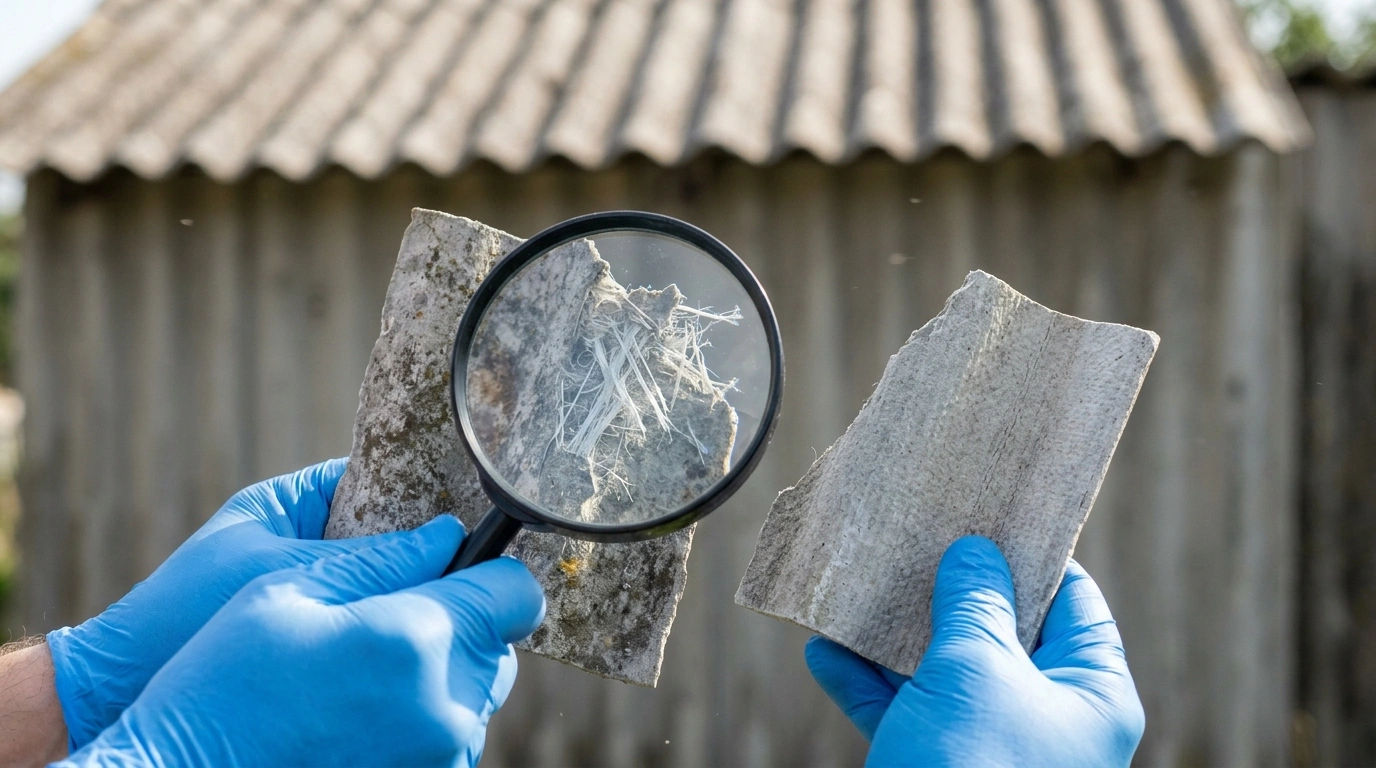
How to tell the difference between asbestos and fibre cement is a question many homeowners ask when they spot old cement sheets, corrugated roofing, wall cladding, or garage panels in a building that may have been built before 2000. It is an important question because asbestos cement and modern fibre cement can look very similar, especially after years of weathering, paint, dirt, and repairs. At the same time, the difference matters for health, renovation safety, and the next steps you should take before cutting, drilling, sanding, or removing anything.
The good news is that there are several clues that can help you compare asbestos cement with non-asbestos fibre cement. The bad news is that visual inspection alone cannot confirm asbestos with complete certainty. You can lower or raise your suspicion by checking the age of installation, surface appearance, labels, stamped logos, golf ball texture, breaking style, and where the material is used. But if you need a final answer, professional asbestos testing or an approved lab asbestos testing process is the only reliable way to confirm it.
In this guide, you will learn the difference between asbestos and fibre cement, the most useful visual differences, where these materials are commonly found, what mistakes to avoid, and what to do if you suspect asbestos-containing materials in your home.
What Is Asbestos Cement?
Asbestos cement is a building material made by mixing cement with asbestos fibres and water to create a tough, durable sheet or molded product. In many older buildings, it was used for corrugated roofing, external cladding, wall lining, ceiling lining, wet area lining, flue pipe, panel sheet, ridging, eaves, gables, and other building materials with asbestos. It became popular because it was fire-resistant, thermally stable, strong, and relatively cheap.
In many countries, especially the UK, Australia, and New Zealand, asbestos cement was widely used from the 1940s through the 1980s, and some materials remained in buildings before 2000. Some sources describe asbestos cement as containing around 10–15% chrysotile-white asbestos fibres, though different products could also include crocidolite or amosite depending on the type and era. That is why terms such as chrysotile, white asbestos, blue asbestos, and brown asbestos often appear in discussions about asbestos cement board and fibrous cement sheets.
You may also see related terms like AIB or asbestos insulation board, but that is not exactly the same as standard asbestos cement sheets. Asbestos insulation board is generally a higher-risk product than hard, bonded non-friable asbestos cement. That distinction matters because not all asbestos-containing materials behave the same way once they are damaged or disturbed.
What Is Modern Fibre Cement?
Modern fibre cement is the safer replacement for old asbestos cement products. Instead of asbestos, it is usually reinforced with cellulose fibres and other modern binding materials. Like older asbestos products, it is designed to be durable, moisture-resistant, and suitable for uses such as cladding, roofing, and wall applications. This is one reason why people often confuse modern fibre cement with asbestos fibre cement.
From a distance, fibre cement can look almost identical to older cement sheets or fibro. It can come in flat sheets, corrugated sheets, and various profiles for external and internal building work. Product names and brands may vary, but the key point is simple: modern fibre cement does not use asbestos as reinforcement, while older asbestos cement does.
That is the heart of the fibre cement vs asbestos comparison. The challenge is that the material you see on a roof, shed, fence, or wall may not reveal its composition just by appearance. That is why many homeowners search how do I know if my fibre cement is asbestos or not.
The Quick Answer: Can You Tell by Looking?
Here is the honest answer: you cannot identify asbestos by sight alone with total certainty.
You can often make an educated guess. For example, a sheet installed before 2000, especially one found in an older building, may deserve more suspicion than a clearly modern product. Surface clues such as a weathered appearance, golf ball texture, old manufacturer markings, or a brittle edge may also help. But even if the material looks like asbestos cement sheeting, it still needs sampling and testing if you want confirmation.
A good rule to remember is this:
Visual clues help you assess risk. Testing is the only way to confirm asbestos.
That single idea is one of the biggest gaps in competitor content. Many pages explain how to tell if cement products contain asbestos, but they do not clearly separate risk clues from proof. For homeowners, that difference is critical.
Visual Differences Between Asbestos Cement and Fibre Cement
When people search how to tell the difference between asbestos and fibre cement, this is the section they care about most. There is no perfect visual formula, but several clues can help.
-
Check the age of the material
The age of installation is often your strongest clue. If the sheet, panel, or roof was installed before 2000, the chance of it being asbestos cement is much higher. In the UK, the 1999 asbestos ban is a key date. In Australia, the full ban came later, often summarized as Australia asbestos ban 2003. In New Zealand, homes and structures built before 2000 also deserve caution.
So if you are wondering, is my fibre cement asbestos if my home was built before 2000, the answer is not automatically yes, but the risk is high enough that you should not guess.
-
Look at the surface texture
Many older sheets described as asbestos cement have a mottled texture, pitted texture, or a faint golf ball surface with small depressions and grooves. This is why so many people search about golf ball texture when identifying suspect sheets.
By contrast, some newer fibre cement products look more uniform, smoother, and cleaner in finish. That said, smooth vs dimpled cement sheet is only a clue, not proof. Paint, weathering, and dirt can disguise the original finish.
-
Notice the colour and weathering
Old asbestos cement may have a grey hue, off-white hue, or an old and muddy appearance after years of exposure. It may look more aged and chalky than a newer replacement sheet. Some homeowners describe it as looking dusty even when it is not visibly damaged.
Modern fibre cement can also weather, but it may look more consistent or more like fresh cement under the surface. Again, this is only one piece of the puzzle.
-
Check for labels, branding, or stamped logos
If you can safely inspect the back, edge, or exposed section of a sheet without disturbing it, labels, brand names, labelling, branding, and stamped logos can offer useful clues. Some older materials were sold under names such as Fibrolite, Durock, Hardiplank, or profile terms like super six. These names do not always prove asbestos, but they can point you in the right direction.
This is one of the best answers to how to spot asbestos branding or stamped logos. If a sheet has markings that tie it to an older era or a product associated with asbestos cement, suspicion increases.
-
Compare the edges and break pattern
People often ask how asbestos breaks compared with fibre cement. Older asbestos cement is often described as hard and brittle, with a clean brittle snap or a break that can look layered. Some contractors say it snaps like a biscuit. Newer fibre cement may break differently depending on the product and thickness.
But this comes with an important warning: do not break a sheet to test it. The breaking style is only relevant if damage already exists. Intentionally snapping or cutting suspect material can release airborne fibres.
Side-by-Side Comparison Table
Here is a simple asbestos cement vs fibre cement visual checklist:
| Feature | Asbestos Cement | Modern Fibre Cement | Can This Confirm Asbestos? |
|---|---|---|---|
| Age | Common in materials installed before 2000 | More likely in newer installations | No |
| Texture | May show golf ball texture, pitting, older surface wear | Often more uniform or smoother | No |
| Colour | Often grey, weathered, chalky, aged | May look cleaner or more consistent | No |
| Branding | May have older labels or stamped logos | May show newer product markings | No |
| Break pattern | Often hard, brittle, layered-looking | Can vary by product | No |
| Composition | Reinforced with asbestos fibres | Reinforced with cellulose fibres | Yes, but only by testing |
The table makes one thing clear: signs a cement sheet may contain asbestos are helpful, but none of them can replace testing.
Where Asbestos Cement Is Commonly Found
If you are trying to work out is cladding made of asbestos cement or whether a roof or shed contains old material, location matters. Asbestos cement sheeting was used in many places, including corrugated roofing, external cladding, wall cladding, ceiling lining, internal wall linings, wet area lining, eaves, gables, verandas, soffit, flue pipe, old sheds, and garages.
You may also find it in fences, wall lining, roof panels, ridging, and older outbuildings. In industrial or commercial settings, it could also appear in areas such as boiler rooms, utility structures, and older service spaces.
This is why terms like asbestos cement roof identification, asbestos in garage roofs and sheds, and asbestos in soffits and eaves are such valuable gap keywords. Many homeowners do not search for “asbestos cement” first. They search for the exact building part they are worried about.
Why Age Matters So Much
If there is one clue that deserves extra attention, it is building age. A structure built or refurbished before 2000 should always make you more careful. A house from the 1980s, a shed from the late 1980s, or an outbuilding from earlier decades may easily contain asbestos cement sheets or fibrous cement sheets.
This does not mean every pre-2000 cement sheet contains asbestos. It simply means the timing fits the risk profile. When people search how to identify asbestos cement in buildings built before 2000, they are asking the right question. Age does not confirm asbestos, but it is one of the strongest context clues available.
What Not to Do With Suspected Asbestos Cement
This is one of the most important sections in the article because many people focus on identification and forget safety. If you suspect bonded asbestos cement, do not drill, sand, cut, snap, grind, scrape, or pressure wash it. Those actions can damage the material and release airborne fibres.
You should also avoid sweeping dust aggressively, using power tools, or pulling sheets down yourself. Many DIY mistakes happen during renovations, demolition, or simple repair work, which is why asbestos DIY removal risks are so high.
If the material is already broken, damaged, cracked, or visibly deteriorating, keep people away from the area and arrange proper advice. Even though non-friable bonded asbestos products are often lower risk than loose asbestos materials, they are not safe to mishandle.
Friable vs Non-Friable Asbestos
A lot of competitor content skips this, but it matters for trust and accuracy.
Friable asbestos is material that can be crumbled by hand pressure when dry, which means it can release fibres more easily. Non-friable asbestos, often called bonded asbestos cement, is more solid because the fibres are locked into a cement matrix. Standard asbestos cement products are often classed as non-friable when they are intact and left in situ.
That sounds reassuring, but it has limits. Non-friable does not mean harmless. Once the sheet is sawn, sanded, drilled, snapped, or badly weathered, the risk rises sharply. This is why asbestos cement health risk when intact is lower than asbestos cement health risk when damaged, but both still require care.
How to Confirm It Safely
If you need a real answer, move beyond guesswork. Asbestos testing is the proper next step. In practice, that may mean a licensed asbestos survey, a professional inspection, or a small sample test sent to an approved IANZ lab or other recognized laboratory depending on your country.
There is also a useful distinction between an asbestos survey and a sample test. A survey looks at the wider property, identifies suspect materials, and assesses condition and risk. A sample test confirms whether one specific material contains asbestos. If you are planning refurbishment, demolition, or major renovation, a wider survey is often more appropriate than testing only one panel.
Some people also search for a water absorption test for asbestos vs fibre cement. While that idea appears online, it should not be treated as a final answer. Informal methods can be misleading. If you are serious about safety, go straight to professional asbestos testing.
Health Risks of Getting It Wrong
The reason this topic matters so much is the health risk. Exposure to asbestos fibres is linked to mesothelioma, asbestosis, lung cancer, and other respiratory diseases. Some reports discuss a 20 to 50 years latency period, which means symptoms may appear decades after exposure.
You may also see references to pleural mesothelioma, peritoneal mesothelioma, lung scarring, fibrosis, reduced lung function, shortness of breath, persistent cough, chest pain, and weight loss. Some data points often used in awareness content include 617 new cases of mesothelioma in 2023, 685 people died in 2022, and a median age at diagnosis of 77. Smoking can also compound the risk, with some sources describing up to 50 times higher lung cancer risk when smoking and asbestos exposure are combined.
This is not meant to alarm readers. It is meant to explain why guessing is not enough.
What to Do Next if You Suspect Asbestos Cement
If you think a roof, sheet, fence, soffit, or wall panel may contain asbestos, take a calm, practical approach.
First, stop work immediately. Second, do not disturb the material. Third, keep children, pets, and unnecessary traffic away from the area. Fourth, arrange testing, a survey, or advice from a registered asbestos contractor or licensed contractor. If the material is damaged, ask about temporary safety steps before removal.
If a positive result comes back, the right response depends on the material’s condition, location, and your local rules. In some cases, intact material can be managed safely. In others, asbestos removal company support is the better path. The key is simple: do not let panic or curiosity push you into unsafe DIY decisions.
Final Thoughts
The difference between asbestos and fibre cement often comes down to clues such as age, texture, colour, labels, branding, golf ball depressions, location, and visible wear. Those clues are useful. They can help you judge whether a material deserves concern. But they cannot give you absolute certainty.
If the material is in a building built before 2000, especially in corrugated roofing, cladding, soffits, eaves, old sheds, or similar locations, treat it with caution. Use visual clues to guide your suspicion, not to make the final call. When in doubt, the safest path is always the same: professional inspection, sampling, and testing.
This article is for general informational purposes only and does not replace advice from a licensed asbestos professional. Visual clues alone cannot confirm the presence of asbestos — always consult a certified asbestos inspector or approved testing laboratory before disturbing any suspect material. If asbestos is confirmed, follow your local regulations and engage a licensed removal contractor.