

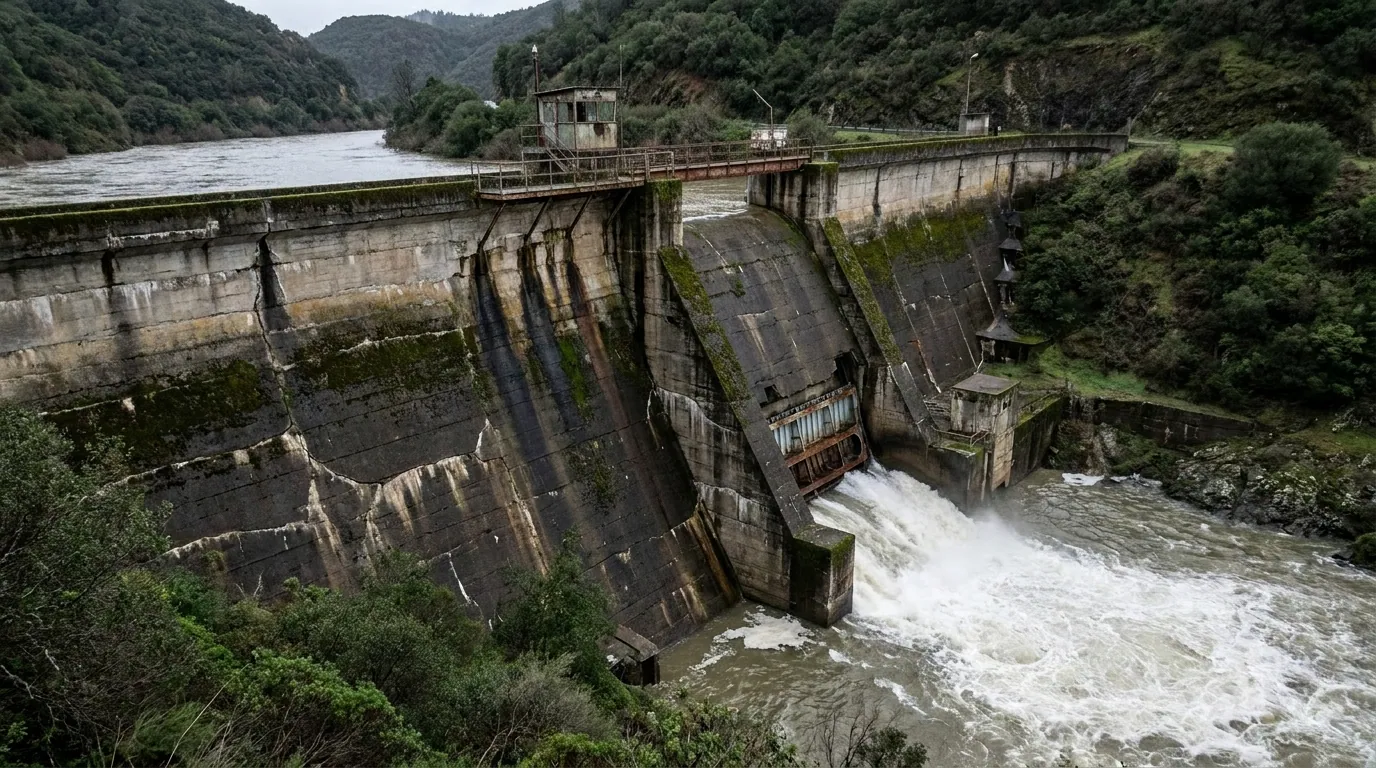
Introduction
Weakest dam in the world is a phrase many people search when they want a simple answer to a frightening question: which dam is most likely to fail, and how dangerous would that be? The problem is that “weakest” is not an official engineering title. Dam experts do not maintain a global ranking that labels one structure as the single weakest dam on Earth. Instead, dams are assessed through factors such as age, structural condition, seepage, spillway capacity, seismic exposure, maintenance history, and downstream hazard potential. That is why search results for this topic often lead to Mullaperiyar Dam in India, while broader global safety discussions frequently point to other high-risk structures such as Mosul Dam.
Still, the search intent behind this keyword is easy to understand. People are not usually looking for a textbook definition. They want to know whether Mullaperiyar Dam, a 130+ year old masonry gravity dam built between 1887 and 1895, is truly unsafe, why it is so controversial, and what could happen if a serious failure ever occurred. The dam’s long history, repeated legal disputes between Kerala and Tamil Nadu, and ongoing public anxiety have made it one of the most discussed dams in South Asia.
This article gives the clear answer people are searching for, but it also goes deeper. It explains why Mullaperiyar Dam is so often associated with the phrase “weakest dam in the world,” how engineers actually judge whether a dam is weak or unsafe, what the real safety concerns are, and how it compares with other dangerous dams globally. Rather than repeating fear-driven claims, the goal is to separate myth, politics, engineering, and public risk in a way that is easy to follow and useful.
So, Which Dam Is Commonly Called the Weakest?
If you look at public discourse, especially in India, Mullaperiyar Dam is the dam most commonly connected to the search phrase “weakest dam in the world.” That association comes largely from activism, media coverage, and regional political debate rather than from a universally accepted engineering standard. In other words, the phrase exists strongly in public conversation, but not as a formal classification used by dam engineers or global regulators.
A better way to phrase the question is often: which dam is considered one of the most unsafe or most dangerous? On that front, global discussions frequently mention Mosul Dam because of its unstable geological foundation and long-running safety concerns. That does not automatically mean Mullaperiyar is safe or unsafe in any absolute sense. It means the word “weakest” is too vague to serve as a reliable engineering label.
So the most accurate answer is this: Mullaperiyar Dam is commonly called the weakest dam in the world in public and regional discourse, but there is no official global ranking that confirms it as the single weakest dam. That distinction matters because many readers arrive expecting a one-line answer, while the truth depends on risk criteria, condition data, and consequence analysis.
Why Mullaperiyar Dam Appears in This Search So Often
There are several reasons why Mullaperiyar Dam dominates this keyword.
First, it is very old. The dam was constructed in the late nineteenth century and opened on 10 October 1895, making it one of the region’s oldest major dams still in service. Age alone does not prove danger, but old infrastructure naturally attracts concern, especially when it still plays an important role in irrigation, water diversion, and hydropower.
Second, it sits inside a highly sensitive political and legal dispute. The dam is located in Kerala, but its waters are used extensively by Tamil Nadu under a long-term historical arrangement often discussed as a 999-year lease agreement. That unusual setup has fueled decades of disagreement over water level, maintenance, control, and whether a new dam should eventually replace the old structure.
Third, safety fears are amplified by geography. The dam lies in the Western Ghats region near Thekkady and Idukki district, an area often described in public debate as being exposed to seismic or heavy-rainfall-related concerns. Whether those risks are sometimes overstated in media narratives is a separate question, but they undeniably shape how ordinary people search and talk about the dam.
Fourth, the stakes feel enormous. Public concern has often centered on the possibility that a major failure could threaten large downstream populations and trigger cascading flood impacts. Technical studies discussing inundation, breach outflow, and flood travel time have added to that perception. Even when these studies are hypothetical models rather than predictions, they strongly influence search behavior.
History and Construction of Mullaperiyar Dam
To understand the controversy, it helps to understand what Mullaperiyar Dam actually is. It is a masonry gravity dam built across the Periyar River. The project began in 1887 under the direction of John Pennycuick, and the dam was completed in 1895. Its core purpose was to divert water eastward for agriculture in the rain-shadow regions that are now part of Tamil Nadu. Over time, the broader project also became linked to power generation.
The dam has often been described with dimensions such as roughly 53.66 m (176 ft) in height and 365.85 m (1,200 ft) in length, along with a reservoir system of major regional importance. It includes 13 spillways, and the wider water-use system has long been valuable for farming, irrigation support, and linked power output. Figures commonly cited in public reference material include reservoir storage values around 443,230,000 m³ and 299,130,000 m³, plus associated generation figures such as 161 MW within the linked system.
One reason the dam attracts scrutiny is its age and original construction style. Older dams like this were built with materials and techniques very different from modern reinforced concrete practice. Public discussions often mention masonry, lime, and surkhi mortar, and critics use these details to argue that the dam belongs to an earlier engineering era. Supporters, however, argue that age does not by itself determine failure risk and that inspection, strengthening, and water management are more important than the calendar alone. That is exactly why the question must move beyond fear-based labels.
How Engineers Actually Decide Whether a Dam Is Weak or Unsafe
This is where many competing articles fall short. A dam is not judged mainly by dramatic headlines. Engineers typically look at a combination of structural integrity, hydrology, foundation behavior, seepage, overtopping risk, spillway capacity, maintenance records, and downstream hazard classification.
For example, overtopping is one of the classic causes of dam failure. If extreme inflows exceed what a spillway system can safely discharge, water can erode or destabilize the structure. Seepage and piping are also major warning signs, because water moving through a dam body or foundation can gradually weaken it from within. Foundation defects matter too. A dam on weak or unstable ground may face risks very different from those faced by a dam built on sound rock.
Engineers also care deeply about consequence, not just condition. A dam may not be the oldest or most visibly damaged, yet still be considered extremely serious if failure would endanger a very large downstream population. That is why the modern concept of a high hazard dam is so important. “High hazard” does not always mean “about to fail.” It often means the consequences of failure would be catastrophic, so the margin for error must be very small.
A useful way to understand this is through a simple framework:
| Risk factor | Why it matters |
|---|---|
| Age and materials | Older construction can require more monitoring and upgrading |
| Seepage / piping | Internal water movement can slowly weaken structure or foundation |
| Spillway capacity | Poor discharge capacity raises overtopping risk during heavy inflow |
| Seismic exposure | Earthquake loading can stress older or vulnerable structures |
| Maintenance history | Inspections, repairs, and operational discipline reduce risk |
| Downstream population | Higher consequence means stricter safety expectations |
That is why saying “weakest dam in the world” is less useful than asking: How is the dam monitored? What are the failure mechanisms? How large is the downstream hazard? Those are the questions that actually matter.
Main Safety Concerns Linked to Mullaperiyar Dam
The main safety concerns raised around Mullaperiyar Dam usually fall into five broad categories.
The first is age. A structure that is more than 130 years old naturally draws questions about deterioration, maintenance burden, and long-term resilience. Older dams can remain functional for long periods, but only if they are properly managed, inspected, and strengthened where needed.
The second is earthquake risk. Public discussion around the dam often refers to seismic sensitivity and asks whether an old masonry structure can withstand strong shaking. That does not mean failure is inevitable, but it explains why the keyword “earthquake risk to Mullaperiyar dam” appears so often in search behavior.
The third is water level and flood pressure. The debate over reservoir level, especially references to around 142 ft, has become central in legal and political argument. For critics, higher water levels mean greater pressure on an old dam. For supporters of continued operation, water levels must be understood within engineering assessment and court-approved control frameworks rather than through fear alone.
The fourth is downstream consequence. Public narratives often mention numbers such as 5–10 million people potentially at risk in broader downstream zones, though such figures depend heavily on assumptions, geography, and scenario modeling. Even when debated, these numbers help explain why the topic provokes such intense public reaction.
The fifth is the wider memory of disaster. The 2018 Kerala flood reinforced public awareness of extreme water events and made many readers more sensitive to stories about dams, flood loading, and emergency response. That event did not prove that Mullaperiyar was on the verge of collapse, but it did strengthen the emotional and search-driven connection between old dams, heavy rainfall, and catastrophic flooding.
What Could Happen If Mullaperiyar Dam Broke?
This is one of the most searched questions, and it needs a careful answer. Technical papers on dam break hazard mapping and HEC-RAS-based flood simulation discuss possible breach outflow, travel time, maximum velocity, and inundation patterns if a failure scenario were modeled. Such studies are useful for emergency planning, but they are not predictions that failure will happen. They are scenario tools.
Some modeled values cited in the case-study literature include very short initial travel times such as 1.8 min, followed by later stages such as 22 min, 25 min, and 122 min for impacts at different points. The same work also references large outflow values like 89121 cumecs and 30458 cumecs, along with velocity figures such as 12.8 m/sec and 6.32 m/sec under modeled conditions. These numbers help explain why the topic feels so alarming to the public.
If a large dam failure were ever to occur, the consequences would depend on the exact breach, reservoir level, downstream flow conditions, and the behavior of linked infrastructure such as the Idukki system. The point of discussing these scenarios is not panic. It is preparedness. In dam engineering, flood-inundation maps, travel-time estimates, and emergency planning are standard ways to reduce risk if the worst ever happens.
A useful rule of thumb: scenario modeling is meant to improve risk mitigation, warning systems, and public safety planning, not to serve as proof that a collapse is imminent.
Mullaperiyar vs Other Dangerous Dams in the World
One reason this topic gets distorted is that people assume old age automatically means the highest risk. But global dam risk has many faces.
Mosul Dam is frequently cited in international discussion because of its geological and foundation-related concerns. Banqiao Dam is remembered because of one of the worst dam disasters in history. The St. Francis Dam and Teton Dam are classic case studies in structural failure and design lessons. The Oroville Dam crisis is a modern example showing how even a major contemporary system can trigger mass evacuation fears when spillway problems emerge.
That comparison matters because it shows there is no single formula for danger. One dam may be controversial because it is old and politically disputed. Another may be feared because of foundation instability. Another may become dangerous during unprecedented rainfall. Another may fail because of overtopping, piping, or poor construction.
Here is the real takeaway: Mullaperiyar is one of the world’s most debated dams, but not necessarily the only or automatically the most technically dangerous one in every respect. Its notoriety comes from a mix of age, public fear, legal conflict, and high downstream consequence. Global comparison gives the article more balance and helps avoid the trap of oversimplification.
Why “Weakest” Is a Misleading Word
The phrase “weakest dam in the world” is powerful for SEO because it is emotional, memorable, and direct. But it is misleading in engineering terms.
A dam can be old without being the weakest. A dam can be controversial without being closest to failure. A dam can be high hazard because of downstream population even if its structural condition is actively monitored. And a dam can be dangerous because of poor foundations or extreme flood exposure even when it is not especially old.
That is why a stronger article does not simply repeat the phrase. It explains the difference between old, unsafe, poorly maintained, high consequence, and most dangerous. For readers, that distinction builds trust. For SEO, it also expands the article’s ability to rank for semantically related searches like “is an old dam always unsafe,” “what causes a dam to fail,” and “most dangerous dam in the world.”
Dam Safety in India: Laws, Monitoring, and Oversight
Any strong article on this topic should mention the modern regulatory context. India now has a Dam Safety Act, 2021, along with a national framework intended to improve surveillance, inspection, operation, and maintenance of specified dams. This matters because public debate about old structures is not just about history. It is also about how current institutions manage risk, monitoring, and emergency planning.
This is an important content gap because most competitor pages spend far more time on fear or technical modeling than on governance. But for real-world safety, laws, inspection standards, rehabilitation, and coordinated oversight are critical. When people ask whether a dam is weak, they are also really asking whether anyone is watching it carefully, updating safety practices, and preparing for low-probability but high-impact events.
In practical terms, modern dam safety depends on:
- regular inspection
- instrumentation and monitoring
- maintenance and strengthening
- clear emergency action planning
- cooperation between agencies and states
That wider context makes the article more useful and more credible.
Frequently Asked Questions
Is Mullaperiyar Dam the weakest dam in the world?
It is commonly called that in public discourse, especially in India, but there is no official global engineering ranking that confirms it as the single weakest dam.
Is Mullaperiyar Dam safe?
That question is debated. Safety assessment depends on engineering inspection, structural condition, reservoir operation, seismic analysis, and emergency planning, not on a slogan alone.
Which dam is often called the most dangerous in the world?
In global discussions, Mosul Dam is often cited as one of the most dangerous because of its long-known foundation issues.
What causes a dam to fail?
Common causes include overtopping, seepage, piping, foundation defects, poor maintenance, and extreme flood stress.
Can an old dam still be safe?
Yes. Age alone does not decide safety. Many older dams remain in service if they are properly monitored, maintained, and upgraded where needed.
Conclusion
Weakest dam in the world may be the phrase people type into Google, but it is not the best way to understand dam safety. In public debate, that label is often attached to Mullaperiyar Dam because the structure is old, politically disputed, heavily discussed, and associated with serious downstream fear. Yet from an engineering point of view, dams are not judged by dramatic labels alone. They are judged by condition, hydrology, seismic resilience, spillway performance, seepage behavior, maintenance, and consequence of failure.
So the most accurate conclusion is this: Mullaperiyar Dam is one of the world’s most debated dams and one of the dams most often linked to the phrase “weakest dam in the world,” but there is no official universal ranking that proves it is the single weakest structure on Earth. A better and more useful question is: which dams carry the greatest risk, why do they carry it, and how well are they being monitored today? That is the question readers really care about, and it is the one that leads to smarter, calmer, and more informed answers.
Disclaimer: This article is for general informational and educational purposes only and should not be treated as professional engineering, legal, or disaster-management advice. Dam safety assessments depend on ongoing inspections, technical studies, maintenance records, and government oversight. Public discussions about dam risks may include opinions, models, or disputed claims that do not necessarily predict actual failure.