

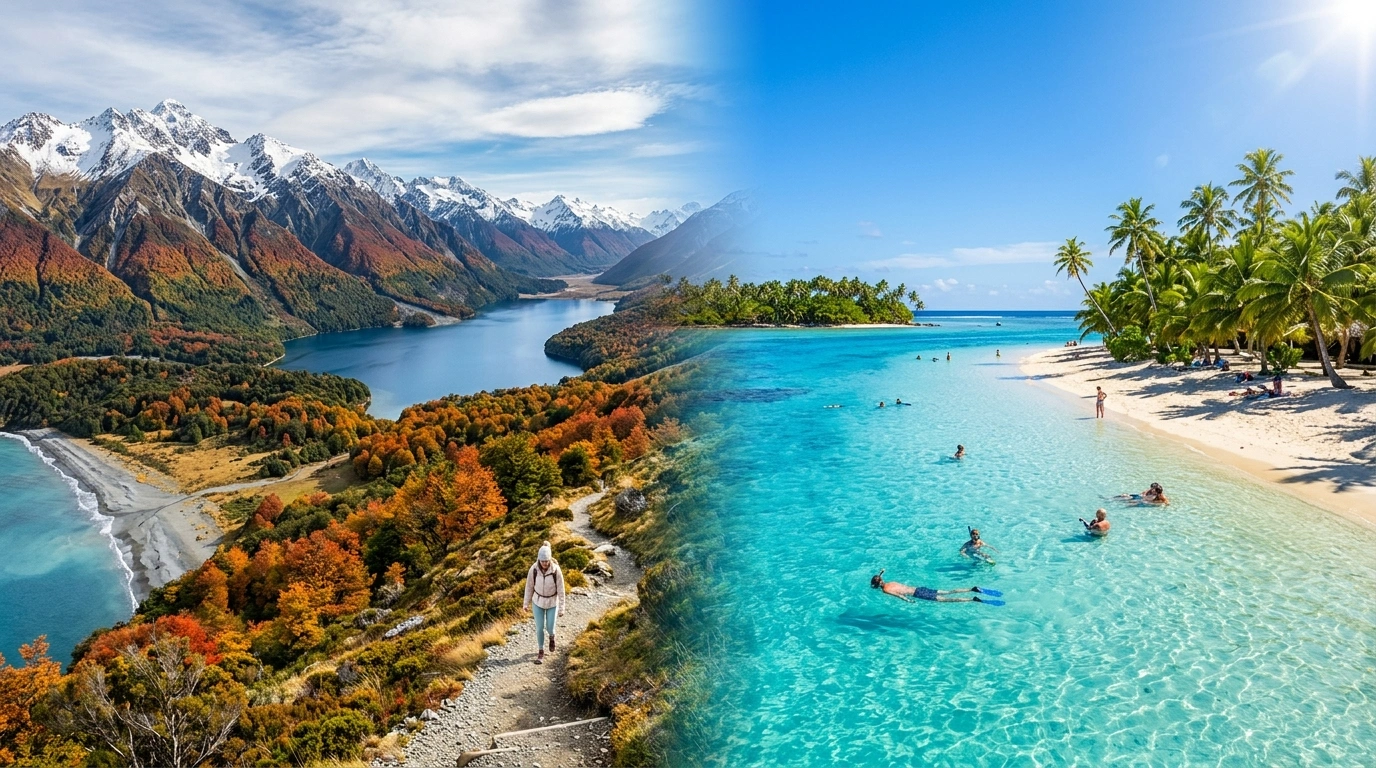
In simple terms, Oceania weather in May is mixed but often very travel-friendly: Australia and New Zealand are in autumn, while many South Pacific islands such as Fiji, Samoa, French Polynesia, and the Cook Islands are moving into the dry season with warm seas, lower humidity, and improving beach weather.
That said, Oceania is not one single climate zone. It includes hot tropical islands, cool alpine regions, dry outback landscapes, mild coastal cities, and rainy mountain areas. So the answer depends heavily on where you plan to go. Northern Australia can still feel warm and sunny, New Zealand’s South Island can feel cool and crisp, and islands like Fiji or Samoa may offer warm tropical conditions ideal for swimming, snorkeling, diving, and island hopping.
If you are planning a trip, May can be one of the most flexible months to visit Oceania because it avoids the peak summer heat in many places while still offering excellent outdoor conditions.
Quick Answer: Oceania Weather in May at a Glance
Oceania weather in May is generally comfortable, but it varies by region. In Australia, May brings mild autumn weather, with warmer conditions in the north and cooler evenings in the south. In New Zealand, May is also autumn, so travelers can expect cooler temperatures, colorful landscapes, rain in some areas, and colder mountain conditions. Across much of the South Pacific, May often marks the start of drier, more pleasant weather after the wetter summer months.
For many tropical islands, daytime temperatures can sit around 28 to 30°C / 84 to 86°F, especially in places like Fiji, Samoa, Tahiti, and the Cook Islands. In temperate regions of Australia and New Zealand, conditions are more likely to range around 18–25°C / 64–77°F, though mountain and southern areas can be cooler.
| Region | May Weather Summary | Best For |
| Australia | Mild to warm, cooler in the south, warmer in the north | Cities, road trips, reef travel, outback |
| New Zealand | Cool autumn weather, rain possible, colder alpine areas | Scenic drives, hiking, photography |
| Fiji & Samoa | Warm, tropical, early dry season | Beaches, snorkeling, cultural travel |
| French Polynesia & Cook Islands | Warm seas, improving rainfall, tropical humidity | Honeymoons, lagoons, island hopping |
| Vanuatu & Tonga | Warm tropical weather with occasional showers | Diving, beaches, relaxed travel |
| Papua New Guinea | Tropical and regionally variable | Culture, nature, adventure travel |
So, is May a good time to visit Oceania? Yes, especially if you match your destination with the weather you want. Choose Fiji or Samoa for warmth, Queensland or the Great Barrier Reef for tropical Australia, Sydney or Brisbane for mild city travel, and New Zealand for autumn scenery.
What Season Is It in Oceania in May?
May falls in autumn in much of Oceania, especially in Australia and New Zealand, because these countries are in the Southern Hemisphere. This often confuses travelers from the United States, Canada, the United Kingdom, and Europe because the seasons are inverted compared with the Northern Hemisphere.
In countries with four clear seasons, March to May is autumn. That means May is late autumn, just before winter begins in June. In southern Australia, this brings cooler mornings, pleasant afternoons, and crisp evenings. In New Zealand, the seasonal shift is more noticeable, especially around Queenstown, Fiordland, Mount Cook National Park, and the South Island, where mountain weather can feel cold.
However, many South Pacific islands do not follow the same four-season pattern. Instead, places like Fiji, Samoa, Vanuatu, Tonga, French Polynesia, and the Cook Islands are better understood through wet season and dry season patterns. In many of these islands, May sits near the beginning of the dry season, which often runs roughly from May to October or April to November, depending on the island.
This is why May weather in Oceania can feel so different from one destination to another. You might need a jacket in New Zealand’s South Island, but only light clothing and reef-safe sunscreen in Fiji.
Oceania Weather in May by Region
Because weather in Oceania during May depends so much on geography, a regional breakdown is the best way to understand it. Oceania includes tropical, subtropical, temperate, desert, alpine, and island climates, so no single forecast can describe the whole region.
| Destination | May Season | Typical Conditions | Travel Feel |
| Australia | Autumn | Mild south, warm north, dry inland | Great for road trips, cities, reef, outback |
| New Zealand | Autumn | Cool, crisp, wetter in places | Scenic, peaceful, good for landscapes |
| Fiji | Early dry season | Warm, humid, less rain than wet season | Excellent for beaches and snorkeling |
| Samoa | Start of dry season | Hot, tropical, occasional showers | Good for culture and coastal travel |
| French Polynesia | Transition to drier weather | Warm lagoons, tropical humidity | Great for honeymoons and resorts |
| Cook Islands | Moving into drier months | Warm, pleasant island conditions | Good for island hopping |
| Vanuatu | Tropical transition | Warm with reduced wet-season intensity | Good for diving and beaches |
| Tonga | Warm and tropical | Mildly humid, less stormy than summer | Good for relaxed island trips |
| Papua New Guinea | Tropical variation | Rain depends on region and elevation | Best planned with local forecasts |
| New Caledonia | Warm but more comfortable | Less humid than summer | Beaches, lagoons, nature |
The key takeaway is that Oceania May climate zones vary widely. If you want warm beach weather, focus on the South Pacific islands or northern Australia. If you want cooler air, dramatic landscapes, and fewer crowds, New Zealand and southern Australia may be better choices.
Australia Weather in May
Australia weather in May is generally pleasant because the country is moving through autumn. The extreme heat of summer has eased in many regions, but the weather is still warm enough for outdoor travel in several parts of the country. Since Australia is huge, the weather changes dramatically between Queensland, Sydney, Melbourne, Tasmania, Darwin, Perth, and the outback.
In southern Australia, cities such as Sydney, Melbourne, Adelaide, Canberra, and Hobart usually feel mild during the day and cooler at night. Sydney may still offer comfortable sightseeing weather, while Melbourne can feel more changeable, with cool winds and occasional rain. Tasmania is noticeably cooler and is better for travelers who enjoy crisp air, nature, and quieter autumn scenery.
In northern Australia, May is often one of the better months to visit. Queensland, Cairns, Darwin, and the Great Barrier Reef are generally warmer than the south, and the heavy humidity and rainfall of the summer wet season have usually reduced. This makes May a strong month for reef trips, snorkeling, diving, rainforest visits, and tropical beach travel. If you are searching for Great Barrier Reef weather in May, the general answer is that it is often warm, more comfortable than peak summer, and popular for marine activities.
The Australian outback can also be more comfortable in May. Places like Alice Springs, Uluru, and inland Northern Territory are much easier to explore than during the hottest summer months. Days can be sunny and dry, while nights may become cool, so travelers should pack both sun protection and a warm evening layer.
For most visitors, May is a practical time to visit Australia because it offers a balance of mild weather, fewer summer crowds, and better conditions for road trips and outdoor sightseeing.
New Zealand Weather in May
New Zealand weather in May is cooler, greener, and more autumnal than Australia’s. If you are wondering, “Is New Zealand cold in May?”, the answer is: it can be cool, especially in the evenings and in the South Island, but it is not winter everywhere yet.
The North Island is usually milder than the South Island. Places like Auckland, Rotorua, Wellington, Bay of Plenty, and Gisborne can still be comfortable for sightseeing, geothermal parks, food tours, and coastal drives. Rain is possible, so it is smart to bring a light waterproof jacket. Wellington can feel windy, while Rotorua and nearby regions may offer comfortable autumn travel with fewer crowds.
The South Island feels cooler and more dramatic in May. Destinations such as Queenstown, Christchurch, Fiordland, Milford Sound, Franz Josef Glacier, Lake Tekapo, and Mount Cook National Park may have crisp air, colder nights, and early hints of winter in alpine areas. Some mountain routes and hiking tracks can be affected by rain, cold, or snow at higher elevations, so travelers should check local conditions before setting out.
May can be beautiful for scenic travel in New Zealand. Autumn colors may still linger in places like Central Otago, and landscapes around Queenstown, Wanaka, and Lake Tekapo can feel peaceful and atmospheric. It is also a good time for photography, wine regions, hot springs, and slower road trips.
For hiking, May can still work well on lower-elevation trails, but alpine routes such as the Tongariro Alpine Crossing or high mountain tracks need careful planning. In short, New Zealand in May is best for travelers who enjoy cool weather, landscapes, culture, wine, and flexible itineraries.
South Pacific Islands Weather in May
South Pacific weather in May is one of the biggest reasons this month can be attractive for Oceania travel. While Australia and New Zealand are cooling down, many South Pacific islands remain warm and tropical. May often brings the beginning of the South Pacific dry season, with less intense rainfall, lower humidity, and improving conditions for swimming, snorkeling, diving, sailing, and beach holidays.
Fiji weather in May is usually warm and appealing. It is often considered one of the better months to visit because the heavy wet-season rains are easing, but the weather is still tropical. Travelers can expect warm days, pleasant evenings, and good conditions for beaches, resorts, and snorkeling. Islands around Nadi, Suva, the Mamanucas, and the Yasawas can still see showers, but May is generally more settled than the wettest months.
Samoa weather in May is also warm and tropical, with the dry season beginning around this time. Apia, Upolu, and coastal villages can still feel humid, but May is usually better for outdoor exploring than the peak wet season. It is a good month for waterfalls, beaches, cultural experiences, and relaxed island travel.
In French Polynesia, including Tahiti, Bora Bora, Huahine, and Moorea, May can be a lovely transition month. The lagoons are warm, the scenery is lush, and rainfall often becomes less dominant than during the wet season. This makes May appealing for honeymoons, overwater bungalows, lagoon tours, and snorkeling.
The Cook Islands, especially Rarotonga and Aitutaki, also become increasingly attractive in May. Warm waters, tropical landscapes, and island-hopping conditions make this a good time for visitors who want a relaxed beach escape. Places like Muri Lagoon and One Foot Island are strongly connected with snorkeling, lagoon cruises, and clear-water experiences.
Across the South Pacific, May is not completely rain-free. Tropical showers can still happen, and humidity may remain noticeable. But compared with the wetter months, May often feels more comfortable and more reliable for outdoor travel.
Is May Rainy in Oceania? Rainfall, Humidity, and Storm Risk
Is May rainy in Oceania? Sometimes, but it depends on where you go. Rainfall in Oceania is highly regional. Some places become drier in May, while others still receive frequent showers due to mountain weather, tropical systems, or coastal conditions.
In many South Pacific islands, May sits near the shift from wet season to dry season. This means rain may still occur, but it is often less intense than in the peak rainy months. You may get short tropical showers followed by sunshine rather than full days of rain. Places such as Fiji, Samoa, Vanuatu, Tonga, French Polynesia, and the Cook Islands can still be humid, but May often brings more stable travel conditions.
In Australia, rainfall varies widely. Northern tropical areas may be drying out after the wet season, while southern cities can see occasional autumn rain. The outback is usually much drier, though nights can become cool.
In New Zealand, rainfall is more common in some regions, especially around the west coast, mountain areas, and places like Fiordland and Milford Sound. This is part of what keeps the landscapes lush, but it also means travelers should pack waterproof clothing.
Cyclone risk is another common concern. The main South Pacific cyclone season is usually associated with the warmer wet-season months, and risk generally decreases by May. However, weather is never guaranteed, so travelers should still check local forecasts, follow official weather warnings, and consider travel insurance for weather-sensitive trips.
Best Places to Visit in Oceania in May for Good Weather
The best places to visit in Oceania in May depend on whether you want warm beaches, mild city weather, or cool scenic landscapes.
For warm weather, Fiji, Samoa, French Polynesia, the Cook Islands, Vanuatu, and northern Australia are strong choices. These destinations are ideal if you want warm seas, sunshine, snorkeling, diving, resorts, and island hopping. Queensland and the Great Barrier Reef are especially appealing because the weather is often more comfortable than during the peak humid season.
For mild city travel, consider Sydney, Brisbane, Perth, Auckland, and Wellington. These places offer a balance of sightseeing, food, culture, museums, coastlines, and outdoor activities without the intense summer heat.
For cool-weather scenery, New Zealand’s South Island, Queenstown, Fiordland, Mount Cook National Park, Lake Tekapo, Tasmania, and southern Australia are excellent options. These regions may not be tropical in May, but they offer dramatic landscapes, crisp air, autumn colors, wine regions, and fewer crowds.
A simple way to choose is this: go to the South Pacific islands for beaches, Australia for variety, and New Zealand for autumn scenery.
Can You Swim, Snorkel, Dive, or Hike in Oceania in May?
Yes, you can enjoy many outdoor activities in Oceania in May, but the best activity depends on the region.
If you want to swim, snorkel, or dive, focus on Fiji, Samoa, the Cook Islands, French Polynesia, Vanuatu, and the Great Barrier Reef. These areas often have warm water in May, and the transition into drier weather can create better conditions for beach travel. Travelers interested in coral reefs, manta rays, green turtles, lagoon tours, and reef conditions will usually find the South Pacific and northern Australia more suitable than cooler southern regions.
If you want to hike or trek, May can be excellent in parts of Australia and New Zealand, but conditions vary. In Australia, May is often more comfortable for hiking than summer, especially in the outback and subtropical regions. In New Zealand, lower-elevation hikes can be beautiful, but alpine routes may be cold, wet, or affected by early winter weather.
For cruises, May can be a good month for parts of the South Pacific, especially as rainfall eases. However, cruise travelers should still watch local forecasts, because tropical weather can change quickly.
What to Pack for Oceania in May
Knowing what to pack for Oceania in May is important because the region has such different climates. A single suitcase for Fiji, New Zealand, and Australia needs to cover warm tropical days, cool evenings, and possible rain.
| Destination Type | What to Pack |
| South Pacific islands | Light clothing, swimwear, sandals, sunscreen, mosquito repellent |
| Australia cities | Light layers, comfortable shoes, casual clothes, light jacket |
| Northern Australia / Reef areas | Breathable clothing, swimwear, reef-safe sunscreen, sunhat |
| New Zealand | Warm layers, waterproof jacket, hiking shoes, fleece or sweater |
| Outback Australia | Sun protection, sunglasses, warm evening layer, sturdy shoes |
For Fiji, Samoa, Tahiti, and the Cook Islands, pack warm-weather clothing, swimming gear, reef-safe sunscreen, sunglasses, a sunhat, and mosquito repellent. A light rain jacket is still useful for tropical showers.
For Australia, pack according to region. Sydney and Melbourne may need layers, while Cairns, Darwin, and Queensland need lighter clothing. For the outback, bring sun protection for the day and something warmer for cool nights.
For New Zealand, bring layers, waterproof clothing, comfortable walking shoes, and a warm jacket, especially if visiting the South Island, Queenstown, Fiordland, or alpine areas.
May Travel Costs, Crowds, and Booking Conditions in Oceania
May can be a smart travel month because it often falls between peak seasons in several parts of Oceania. In Australia and New Zealand, May is outside the busiest summer holiday period, so some destinations may feel quieter and more affordable. This can be useful for travelers planning road trips, city breaks, or scenic travel.
In the South Pacific, May can mark the start of stronger travel demand as weather improves and the dry season begins. Visitor numbers may begin to rise in places like Fiji, French Polynesia, Cook Islands, and Samoa, especially at popular resorts. However, May can still offer better value than peak months such as June to August in some island destinations.
If you want good weather and fewer crowds, May is often a strong compromise. It can offer good deals, pleasant conditions, and shoulder-season advantages, depending on the destination.
Forecast vs Climate Averages: What Travelers Should Know Before Going
When researching average weather in Oceania in May, remember that climate averages are not the same as a real-time forecast. Averages help you understand typical patterns, but actual weather can change because of microclimates, tropical systems, mountain weather, ocean temperatures, and regional rainfall differences.
This matters especially in places like New Zealand, where mountains can create fast-changing conditions, and in the South Pacific, where tropical showers may appear even during generally drier months. It also matters in Australia, where the difference between Tasmania, Queensland, Sydney, Darwin, and the outback can be huge.
Use climate averages for planning, but check a local weather forecast before hiking, cruising, diving, driving long distances, or visiting remote islands.
Content Gaps: What Other Oceania Weather Guides Often Miss About May
Many travel guides explain the best time to visit Oceania, but they do not always answer the exact question: what is the weather like in Oceania in May? A strong May-specific guide should go beyond general season advice and explain how weather affects real travel decisions.
One missing angle is a clear country-by-country comparison. Travelers need to know that Fiji and Samoa may be warm and beach-friendly, while New Zealand’s South Island can be cold and autumnal. Another gap is rainfall and cyclone risk. Many articles mention wet and dry seasons but do not clearly explain whether May is rainy or risky for tropical storms.
Another important gap is activity-based planning. May weather affects whether you should choose snorkeling, diving, hiking, city travel, road trips, cruises, wine regions, or alpine landscapes. Packing is another missed opportunity because travelers need different clothing for South Pacific islands, Australia’s outback, and New Zealand’s mountains.
By covering these practical questions, an article can better satisfy search intent and offer stronger value than broad “best time to visit” pages.
FAQs About Oceania Weather in May
Is May a good time to visit Oceania?
Yes, May is a good time to visit Oceania for many travelers. It offers mild autumn weather in Australia and New Zealand and warmer, drier conditions across many South Pacific islands. It is especially good for travelers who want fewer crowds than peak season.
Is Oceania warm in May?
Some parts of Oceania are very warm in May. Fiji, Samoa, French Polynesia, Cook Islands, Vanuatu, and northern Australia are usually warm, while New Zealand, Tasmania, and southern Australia are cooler.
Is May rainy in Oceania?
May can bring rain in some regions, especially New Zealand’s west coast, mountain areas, and tropical islands, but many South Pacific destinations are moving into the dry season, so rainfall is often less intense than during the wettest months.
Which parts of Oceania are warmest in May?
The warmest places in Oceania in May are usually Fiji, Samoa, French Polynesia, Cook Islands, Vanuatu, Tonga, northern Queensland, Darwin, and the Great Barrier Reef.
Is New Zealand cold in May?
New Zealand can be cool in May, especially in the South Island, alpine areas, and evenings. The North Island is usually milder, but rain and wind are possible.
Can you swim in Oceania in May?
Yes, you can swim in many parts of Oceania in May, especially in Fiji, Samoa, Cook Islands, French Polynesia, Vanuatu, and the Great Barrier Reef. Cooler regions such as New Zealand and southern Australia may not feel ideal for casual swimming.
What should I pack for Oceania in May?
Pack based on your route. Bring light clothing, swimwear, sunscreen, sunglasses, and mosquito repellent for tropical islands. Bring layers, waterproof clothing, warm jackets, and comfortable shoes for New Zealand and southern Australia.
Conclusion: Is May a Good Month for Oceania Weather?
So, what is the weather like in Oceania in May? It is a mix of mild autumn weather, warm tropical islands, cooler southern landscapes, and improving dry-season conditions across much of the South Pacific.
May is a strong month for travelers because it offers variety. You can enjoy warm beaches in Fiji, snorkeling in the Cook Islands, reef trips in Queensland, city travel in Sydney, or autumn scenery in New Zealand. The key is choosing the right destination for your preferred weather.
For warm seas and beach weather, look to the South Pacific and northern Australia. For crisp landscapes and scenic travel, choose New Zealand or southern Australia. With smart packing and local forecast checks, Oceania in May can be an excellent and rewarding time to travel.
This article is for general informational purposes only. Weather conditions across Oceania vary significantly by region and can change without notice. Always check current local forecasts, official travel advisories, and entry requirements before booking or traveling. The author is not responsible for weather-related disruptions to travel plans.