

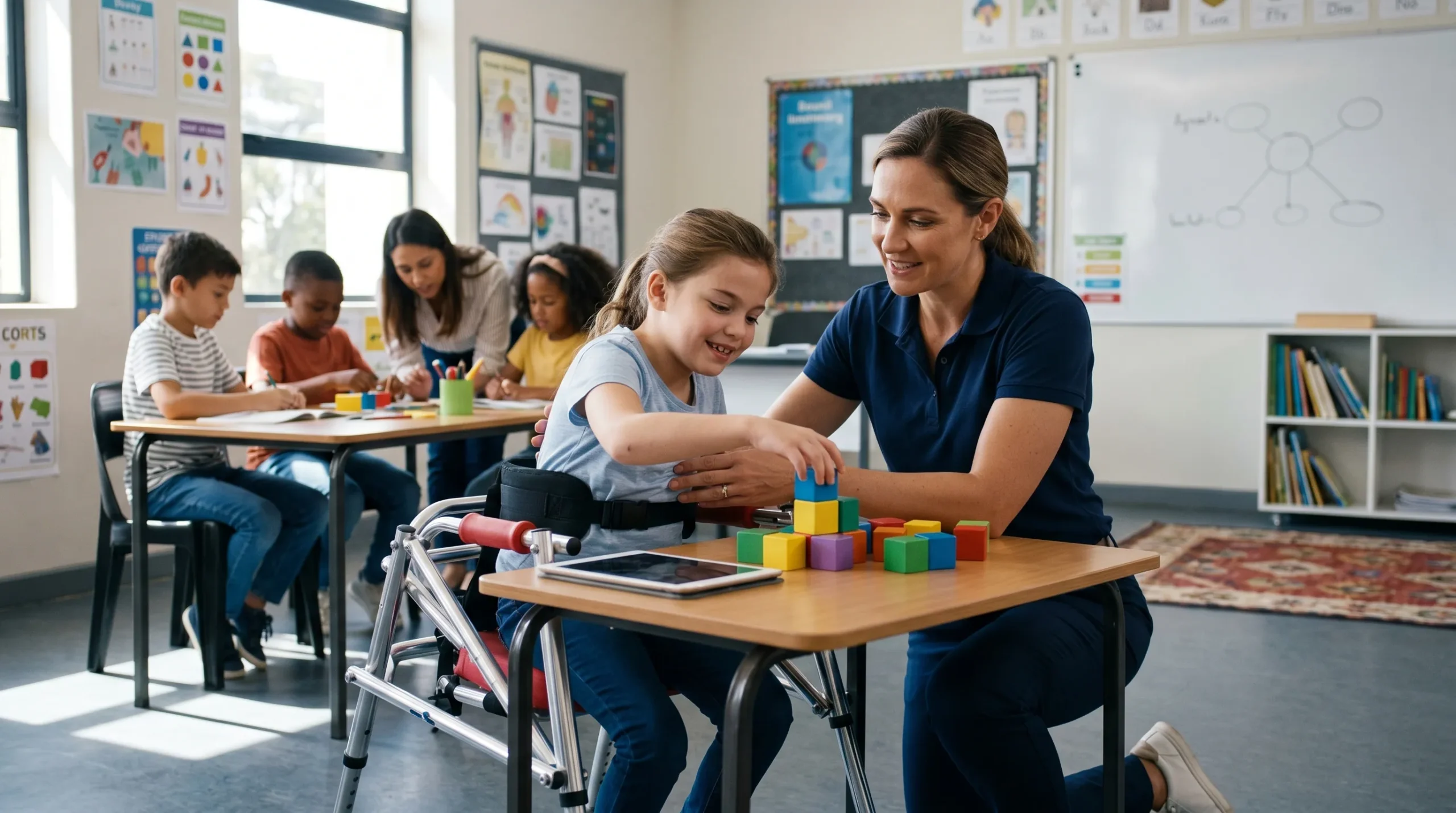
Discuss the role of physiotherapist for students with special needs by looking at how this professional helps children and young people improve movement, balance, posture, mobility, independence, and participation in school life. A physiotherapist does much more than guide exercises. In an educational setting, this professional supports students so they can sit comfortably, move safely, join classroom activities, take part in play and physical education, and access learning with confidence.
For many students with special needs, school is not only a place for academic growth. It is also where they develop social skills, self-care habits, physical confidence, and independence. Some students may have difficulty with gross motor skills, functional mobility, balance, coordination, motor planning, or stability. Others may need help with postural management in the classroom, safe transfers in school, seating and positioning support, or mobility around the school campus. This is where school-based physiotherapy becomes highly valuable.
A physiotherapist works as part of a multidisciplinary team, often alongside teachers, parents, caregivers, special educators, occupational therapists, speech specialists, and physical therapy assistants. The goal is not simply treatment for treatment’s sake. The real aim is to improve the student’s access to education, school participation, and student independence at school. In other words, the physiotherapist helps remove physical barriers that prevent a child from learning and participating fully.
What Is a Physiotherapist and Why Is the Role Important in Special Education?
A physiotherapist is a trained health professional who helps people improve physical function, movement, strength, balance, and mobility. In special education, the role becomes even more important because many students need physical support to take part in everyday school routines. A student may be bright, curious, and eager to learn, but still struggle to sit upright, walk safely in hallways, move between classes, or join group activities. Without the right support, these physical challenges can affect academic performance, confidence, and participation.
This is why physiotherapy in special education matters. The physiotherapist focuses on the student’s functional needs in real school environments. Instead of only thinking about exercises in a clinic, the therapist looks at how the student manages in the classroom, on the playground, in the therapy gym, during PE participation, and in daily transitions such as moving from desk to mat or from class to lunch. This makes the work highly student-centered and practical.
In many cases, the physiotherapist also contributes to an individualized program that reflects the student’s physical and educational goals. This may be part of a broader school program, IEP, or IFSP physical therapy service, depending on the system. The therapist’s role is not isolated. It is closely linked to promote learning, improve student functioning, and support inclusive education.
Main Roles of a Physiotherapist for Students With Special Needs
The role of physiotherapist for students with special needs is broad and deeply connected to daily school life. One major role is assessment. The physiotherapist evaluates the student’s functional movement, gross motor skills, balance, coordination, mobility, stability, and overall function. This helps identify where support is needed.
Another important role is improving functional mobility. A child may have trouble walking, standing, sitting, climbing stairs, or moving safely from one space to another. The physiotherapist creates strategies and activities to build strengthening, posture, endurance, and confidence. These interventions may include guided movement practice, therapeutic activities, stretching, and child-friendly therapy activities that feel natural rather than forced.
The physiotherapist also supports independence. For students with special educational needs, even small improvements in posture or balance can make a big difference. A child who can sit more comfortably may focus better in class. A student who can move more safely around the campus may join more group activities. A child who has better stability may take part in playground access, adapted physical activity, and PE participation with fewer barriers.
Equally important is the therapist’s role in helping students participate in the life of the school. This includes classroom access, school performance, and involvement in non-academic activities. The physiotherapist helps make sure physical limitations do not become educational limitations.
How Physiotherapists Support Learning and Classroom Participation?
Many people think physiotherapy is only about walking or exercise, but it also has a direct effect on learning. A student cannot learn well if they are uncomfortable, tired from poor posture, or unable to move safely in class. This is why positioning for learning and postural management in the classroom are so important.
A physiotherapist may recommend seating and positioning support so a student can sit upright, see the board, reach materials, and stay comfortable during lessons. They may suggest classroom adaptations for mobility needs, such as adjusted desk placement, extra space for wheelchairs, safer movement routes, or supportive seating equipment. These changes help improve access to education in a very practical way.
The therapist may also work with teachers to adjust routines. For example, a student with low muscle tone, poor balance, or cerebral palsy may need extra support during transitions. A student on the autism spectrum may benefit from movement-based strategies that improve body awareness and motor planning. These are not minor details. They can strongly affect participation, comfort, and concentration.
A helpful way to understand this is through a simple classroom example:
| School Challenge | How the Physiotherapist Helps | Likely Benefit |
|---|---|---|
| Poor sitting posture | Recommends supportive seating and positioning | Better comfort and attention |
| Difficulty moving between classes | Trains safe walking or transfer strategies | Greater independence |
| Limited PE participation | Adapts movement tasks and builds balance | Inclusion in physical activity |
| Trouble accessing classroom materials | Suggests posture and desk adjustments | Improved classroom access |
This is how therapy goals linked to learning become meaningful in real school life.
The Physiotherapist’s Role in Inclusive Education
A strong article on this topic must also explain the role of physiotherapist in inclusive education. Inclusive education means students with disabilities or challenges should have fair opportunities to learn and participate alongside their peers. The physiotherapist supports this by reducing barriers to school participation.
For example, a student may want to join classroom games, assemblies, sports, or group learning, but struggle with mobility, balance, or fatigue. The physiotherapist helps create realistic, supportive solutions. That may involve assistive technology for mobility at school, adapted movement tasks, safer routes, better positioning, or collaboration with staff so the student can join in more fully.
This role matters because inclusive education is not only about being physically present in school. It is about meaningful participation. A child who cannot access the playground, move safely to class, or take part in PE is not fully included. The physiotherapist helps bridge that gap and supports school inclusion, participation-based goals, and student independence at school.
Collaboration With Teachers, Parents, and the Special Education Team
A physiotherapist cannot work alone in a school setting. Real progress often depends on collaboration with teachers and parents. The best results usually come from a strong family-school-therapist partnership.
Teachers see how the student functions during lessons, transitions, and group work. Parents and caregivers understand the child’s daily routines, strengths, and struggles outside school. The physiotherapist brings professional knowledge of movement, mobility, stability, and therapeutic support. When these people work together, support becomes more consistent.
For example, the therapist may teach staff how to assist with safe transfers in school, how to support posture during class, or how to encourage movement without creating stress. Parents may be shown simple home activities to strengthen the child’s physical abilities in natural ways. This teamwork helps build continuity between home and community and the school environment.
As one practical principle, many therapists follow a simple idea: the best therapy is the therapy that fits into real life. That is especially true for students with special needs in school, because school is where so much daily participation happens.
Common Needs and Conditions a Physiotherapist May Support
A physiotherapist may support students with a wide range of needs. Some have autism spectrum disorder, cerebral palsy, Down syndrome, hearing disorders, speech and language delays, sensory issues, or special motor needs. Others may not have a specific diagnosis but still show difficulty with gross motor development, functional mobility, balance, coordination, or developmental milestones.
A student with cerebral palsy may need help with posture, orthotics, walking patterns, or transfers. A child with Down syndrome may need support for low muscle tone and stability. A student on the autism spectrum may struggle with body awareness, movement planning, or group physical activities. A child recovering from illness, accident, or injury may also need short-term support.
The key point is that the physiotherapist looks beyond the label. The focus is always on how the child functions in daily school life. What can the student do comfortably? What makes participation harder? What supports will improve overall function and school participation?
Interventions and Strategies Physiotherapists Use in School
The interventions used in school-based physiotherapy are usually practical and functional. A physiotherapist may design activities to improve balance, coordination, gross motor skills, strengthening, and functional mobility. Sessions may include walking practice, stair practice, posture work, stretching, or guided play.
In younger children, therapy through play is especially effective. Activities using balls, swings, slides, toys, or obstacle courses can improve motor skills while keeping the child engaged. For older students, the therapist may focus more on mobility around school campus, PE participation, endurance, and movement strategies that fit the student’s daily schedule.
Equipment is another important part of the role. The physiotherapist may assess the need for standers, wheelchairs, orthotics, or other mobility aids. They may also recommend changes to classroom furniture or positioning systems. These are not just medical tools. They are part of school-based rehabilitation for students because they support learning access and safety.
Here is a short case-style example:
Case example: A student with poor balance and low muscle tone struggled to move from the classroom to the playground safely. After assessment, the physiotherapist introduced balance activities, supported walking practice, and seating adjustments. Within weeks, the student showed better confidence, safer movement, and greater involvement in recess and class transitions.
This kind of practical outcome shows the real benefits of physiotherapy for students with special needs.
School-Based Physiotherapy vs Clinic-Based Physiotherapy
It is also important to explain the difference between clinical and school physiotherapy. In a clinic or outpatient physical therapy setting, treatment may focus mainly on the child’s medical or physical condition. The goals may be broad, such as improving muscle strength, reducing pain, or supporting recovery after injury.
In contrast, school-based physical therapy focuses on functional goals in education. The main question is not only, “Can this child improve physically?” but also, “Can this student participate better in school?” That means goals are often tied to classroom access, safe movement, transitions, play, PE, and daily learning activities.
Both settings are valuable, but they serve different purposes. A student may even benefit from both. One supports broader health or rehabilitation needs, while the other supports access to the educational program in the natural environment of school.
Physiotherapy, IEPs, IFSPs, and Individualized Support Plans
In many systems, physiotherapy is connected to individualized support planning. Young children under age 3 may receive help through Early Intervention and an IFSP, or Individual Family Service Plan. After age 3, support may continue in preschool or school-age settings through an IEP, or Individualized Educational Program.
This matters because the physiotherapist’s work is often written into measurable goals. These might include safer walking between classes, improved sitting tolerance, greater independence in school routines, or better access to PE and group activities. The therapist may also take part in student mobility assessment in school and help the team decide how much support is needed.
When physiotherapy is linked to an individualized plan, the service becomes more focused and meaningful. It is not random exercise. It is a targeted support service connected to learning, participation, and function.
Benefits of Physiotherapy for Students With Special Needs
The benefits of physiotherapy for students with special needs can be seen across the school day. Physically, students may improve in balance, mobility, coordination, posture, strength, and endurance. Functionally, they may become more independent during transitions, class routines, and physical activities.
There are also emotional and social benefits. A child who can move more safely and comfortably often becomes more confident. Better mobility can mean more involvement in group play, school events, and peer interaction. This can support social skills, confidence, and a stronger sense of belonging.
Educationally, physiotherapy can improve attendance and access support by making the school environment easier to manage. When students are more comfortable and independent, they are better able to focus on learning rather than on physical struggle.
Challenges Physiotherapists Face in Supporting Students With Special Needs
Even though the role is highly valuable, there are challenges. Some schools have limited therapy resources, heavy caseloads, or not enough equipment. Staff may need more training in positioning, transfers, or physical support strategies. There may also be a gap between recommendations and daily follow-through.
Research-based discussions of school physiotherapy have highlighted broad themes around collaboration, service delivery, and how physiotherapists are integrated into education settings. In one review window covering 2015 to 2025, 15 selected studies identified 3 main themes related to school-based physiotherapy experiences and implementation. That kind of finding suggests the role is important, but also still developing in many settings.
Another challenge is balancing therapy with real school routines. A student cannot miss essential learning all the time for therapy sessions. That is why modern school-based physiotherapy-led interventions for children with disabilities often aim to fit naturally into the day.
Why Physiotherapy Matters for Student Independence and Long-Term Development
In the long term, physiotherapy helps students build more than physical skill. It supports life skills, self-care, confidence, participation, and school readiness. It can also help with transition planning for students with disabilities, especially when they move into new classes, new school levels, or more demanding physical environments.
A student who learns safe movement, better posture, and greater independence at school may carry those gains into home life and the community. That is why the work of the physiotherapist matters so much. It supports not only the body, but also the student’s ability to learn, interact, and grow with dignity.
Conclusion
The role of physiotherapist for students with special needs is both practical and powerful. A physiotherapist helps students improve movement, balance, mobility, gross motor skills, and posture, but the role goes far beyond physical exercise. In a school context, the physiotherapist helps students gain classroom access, join activities, move safely, and become more independent throughout the day.
By working with teachers, parents, and the special education support team, the physiotherapist creates support that is meaningful in real life. This includes positioning for learning, safe transfers, mobility around school, PE participation, and inclusive education support services. In the end, physiotherapy helps remove barriers that stand between the student and full participation in school.
That is why physiotherapy should be seen as a key part of student-centered therapy, inclusive education, and access to education for learners with special needs.
Disclaimer
This article is for general informational purposes only and does not replace professional advice. The content is based on typical practices and research but may not apply to every student or situation. Readers should consult a licensed physiotherapist or educational specialist for personalized guidance.