

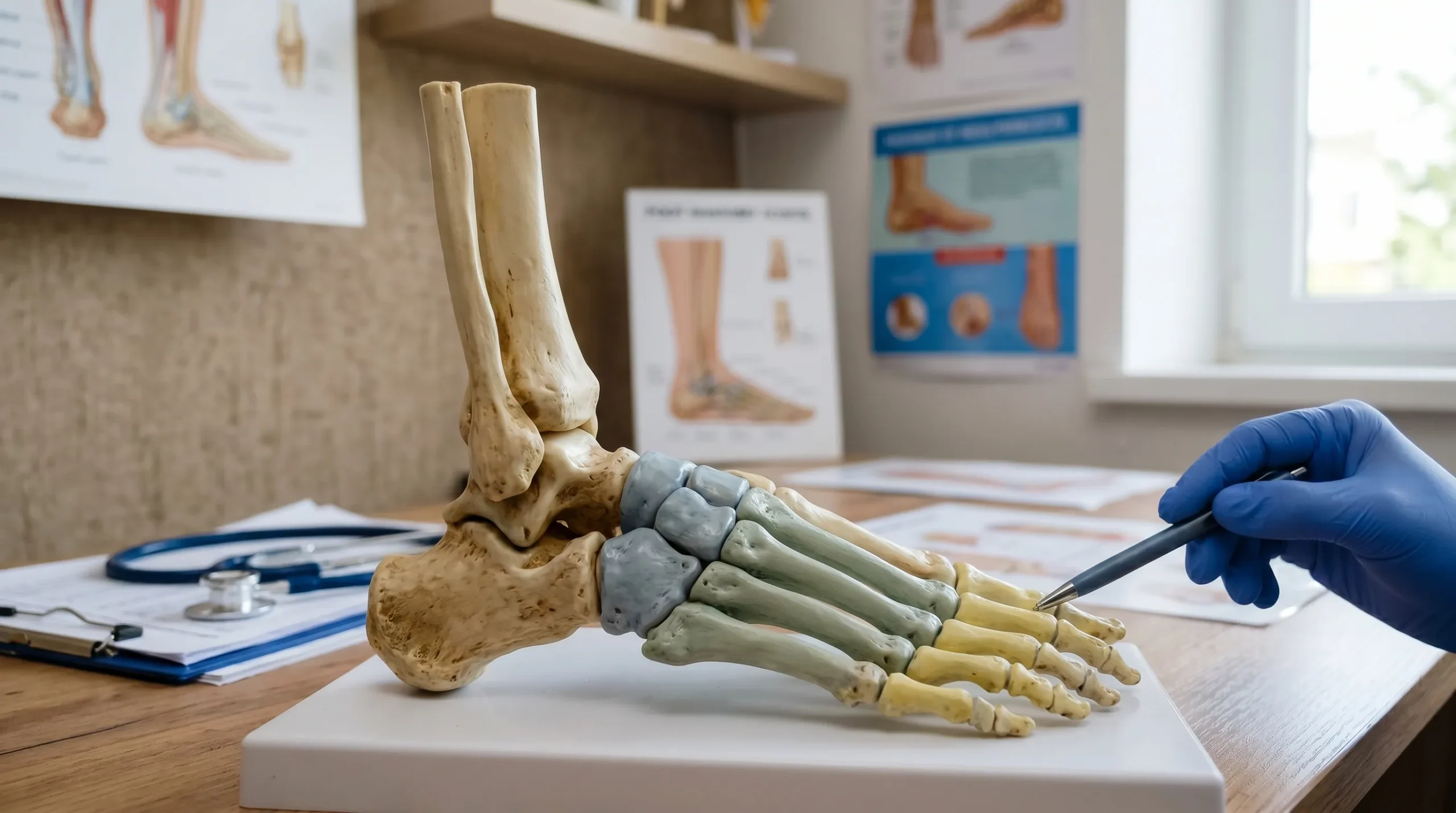
How many bones is in the foot is a common way people search this question, but the correct wording is “how many bones are in the foot?” The simple answer is that each human foot has 26 bones. These foot bones work together with joints, ligaments, tendons, and muscles to help you stand, walk, run, jump, balance, and absorb shock.
The bones of the foot may look small compared with other bones in the human body, but they carry a huge responsibility. Every step places pressure on the feet, and the structure of the human foot bones helps distribute body weight while keeping the foot flexible and stable.
In this guide, you will learn exactly what the 26 bones of the foot are called, how they are grouped, how many bones are in both feet, whether ankle bones count as foot bones, and why some people may have extra bones in the foot.
Quick Answer: How Many Bones Are in the Foot?
Each human foot has 26 bones. Since most people have two feet, both feet together usually contain 52 bones.
The 26 bones in each foot are divided into three main groups: 7 tarsals, 5 metatarsals, and 14 phalanges. The tarsal bones form the back and middle part of the foot, the metatarsal bones form the long bones through the middle and front of the foot, and the phalanges are the toe bones.
Here is the easiest way to remember the standard foot bone count:
| Bone Group | Number of Bones in One Foot | Location |
| Tarsals | 7 | Back and middle of the foot |
| Metatarsals | 5 | Middle/front of the foot |
| Phalanges | 14 | Toes |
| Total | 26 | One foot |
| Both feet combined | 52 | Two feet |
So, if someone asks “how many bones are in each foot?”, the answer is 26 bones. If they ask “how many bones are in both feet?”, the answer is 52 bones.
Foot Bones Table: The 26 Bones by Group
The foot bones table below breaks down the 26 foot bones in a simple way. This helps explain what the bones in the foot are called without making the anatomy confusing.
| Group | Number | Main Bones / Parts | Main Job |
| Tarsals | 7 | Talus, calcaneus, navicular, cuboid, 3 cuneiform bones | Support the heel, ankle connection, arch, and midfoot |
| Metatarsals | 5 | First through fifth metatarsals | Support weight and form the ball of the foot |
| Phalanges | 14 | Toe bones | Help with balance, pushing off, and toe movement |
| Total | 26 | All foot bones combined | Support, balance, flexibility, and movement |
The largest bone in the foot is the calcaneus, also called the heel bone. The talus sits above the calcaneus and helps connect the foot with the ankle. The metatarsals are the long bones you can think of as the bridge between the ankle area and the toes. The phalanges make up the toes, including the big toe, also called the hallux.
The 3 Main Groups of Foot Bones
The bones of the foot are usually grouped into three main groups of foot bones: tarsals, metatarsals, and phalanges. This grouping makes foot anatomy much easier to understand.
The tarsals are found in the back and middle of the foot. They include important bones such as the talus, calcaneus, navicular, cuboid, and cuneiform bones. These bones help form the hindfoot and midfoot.
The metatarsals are the 5 long bones in the middle/front part of the foot. They connect the tarsals to the toes and help carry weight during walking and running.
The phalanges are the 14 bones in the toes. They help the foot push off the ground and maintain balance during movement.
Together, these three groups create a strong but flexible structure that supports standing, walking, running, jumping, shock absorption, and mobility.
Tarsals: The 7 Bones at the Back and Middle of the Foot
The tarsals are the 7 tarsal bones located mainly in the back and middle of the foot. They are important because they help form the heel, support the arch of the foot, and connect the foot with the ankle.
The 7 tarsals are:
| Tarsal Bone | Simple Explanation |
| Talus | Helps form the ankle joint and transfers weight from the leg to the foot |
| Calcaneus | The heel bone and the largest bone in the foot |
| Navicular | Supports the inner side of the midfoot |
| Cuboid | Supports the outer side of the midfoot |
| Medial cuneiform | One of three wedge-shaped bones near the arch |
| Intermediate cuneiform | Middle cuneiform bone |
| Lateral cuneiform | Outer cuneiform bone |
The talus is especially important in foot and ankle anatomy because it sits between the lower leg and the foot. It works with the tibia and fibula to help form the ankle joint. The calcaneus, or heel bone, absorbs pressure when your heel hits the ground.
The navicular, cuboid, and cuneiform bones help shape the midfoot and support the medial longitudinal arch. Without these bones, the foot would not be able to handle weight, adapt to uneven surfaces, or move smoothly during daily activities.
Metatarsals: The 5 Long Bones in the Middle of the Foot
The metatarsals are the 5 metatarsal bones that run through the middle and front of the foot. They are numbered from the first metatarsal to the fifth metatarsal, starting from the big toe side and moving toward the little toe side.
These bones help form the ball of the foot, which takes pressure when you walk, run, jump, or push off the ground. The metatarsals also connect the tarsal bones to the phalanges, making them an important bridge between the midfoot and toes.
The first metatarsal is connected to the big toe and plays a major role in pushing off during walking. The second, third, fourth, and fifth metatarsals support balance and weight distribution across the forefoot.
Because the metatarsals carry a lot of pressure, they are common sites for stress fractures and other foot bone injuries. For example, runners, dancers, athletes, and people who suddenly increase walking or training may develop pain in the top of the foot or ball of the foot due to irritation or injury around the metatarsal bones.
Phalanges: The 14 Bones in the Toes
The phalanges are the toe bones. Each foot has 14 phalanges, and these small bones help with balance, flexibility, pushing off, and movement.
The big toe, also called the great toe or hallux, has 2 phalanges: a proximal phalanx and a distal phalanx. The other four toes each have 3 phalanges: a proximal phalanx, middle phalanx, and distal phalanx.
That gives the foot:
| Toe Area | Number of Bones |
| Big toe / hallux | 2 phalanges |
| Other four toes | 12 phalanges total |
| All toes combined | 14 phalanges |
The toes may seem small, but they are very important. They help you grip the ground, adjust your balance, and push forward while walking or running. The big toe is especially important because it carries a lot of pressure during the final push-off phase of each step.
Toe injuries are also common. A stubbed toe, broken toe bone, arthritis in the big toe joint, or stiffness in the hallux can make walking painful because the phalanges are involved in nearly every step.
What Are the 26 Bones of the Foot Called?
If you are wondering what the 26 bones of the foot are called, the easiest answer is to name them by group.
The 7 tarsal bones are the talus, calcaneus, navicular, cuboid, medial cuneiform, intermediate cuneiform, and lateral cuneiform.
The 5 metatarsal bones are the first, second, third, fourth, and fifth metatarsals.
The 14 phalanges are the toe bones. The big toe has 2 phalanges, while each of the other four toes has 3 phalanges.
So, in simple terms, the 26 bones in the foot are:
- 7 tarsals
- 5 metatarsals
- 14 phalanges
A helpful way to remember this is: 7 + 5 + 14 = 26.
These bones form the bony framework of the foot. They are supported by cartilage, ligaments, tendons, muscles, and joints, which allow the foot to move while still staying strong enough to carry body weight.
How Many Bones Are in Both Feet?
Both feet together usually have 52 bones. Since one foot has 26 bones, the math is simple: 26 bones in the right foot + 26 bones in the left foot = 52 bones in both feet.
This is one reason the feet are such an important part of the skeletal system. A large number of the bones in the human body are found in the feet. These bones are not there by accident. They help your feet handle pressure, adjust to different surfaces, absorb shock, and support your body during movement.
So, the answer to “how many bones are in both feet?” is 52 bones, based on the standard adult human foot structure.
Are Ankle Bones Counted as Foot Bones?
Many people confuse foot bones vs ankle bones, so this is an important question. The answer depends on which bones you are talking about.
The talus is counted as one of the 7 tarsal bones of the foot. It also helps form the ankle joint, which is why it is often discussed in both foot anatomy and ankle anatomy.
However, the tibia and fibula are not foot bones. They are the two lower-leg bones that meet the talus at the ankle. The tibia is the larger shin bone, and the fibula is the thinner bone on the outer side of the lower leg.
So, when people ask “are ankle bones counted as foot bones?”, the clearest answer is:
The talus is a foot bone that helps form the ankle joint, but the tibia and fibula are lower-leg bones, not foot bones.
This is why the standard count stays at 26 bones in the foot. Even though the foot and ankle work closely together, not every bone involved in ankle movement is counted as a foot bone.
Why Does the Foot Have So Many Bones?
The foot has 26 bones because it needs to be both strong and flexible. A single solid bone would not allow the foot to bend, balance, absorb shock, or adapt to different surfaces. Many smaller bones make the foot more useful for real movement.
The foot bones help with several important jobs. They support body weight when you stand. They help with balance when you shift position. They create mobility when you walk or run. They also allow the foot to absorb impact when your heel touches the ground and then push off through the toes.
The tarsals provide a strong base in the back and middle of the foot. The metatarsals help transfer weight through the middle and front of the foot. The phalanges help with toe movement and pushing off.
This combination gives the foot the right mix of support, stability, flexibility, shock absorption, and propulsion. In other words, the foot has many bones because it has many jobs.
Can Some People Have More Than 26 Bones in the Foot?
The standard answer is that each foot has 26 bones, but some people may have small extra bones called accessory bones. These are normal anatomical variations, and they do not always cause problems.
Common examples include the accessory navicular bone, os trigonum, and os peroneum. Some people may also have small sesamoid bones, especially near the big toe area. Sesamoid bones are small bones embedded in tendons, and they can help with pressure and movement.
This is one reason you might see slightly different explanations online about the number of bones in the foot. For most educational and anatomy purposes, the accepted answer is still 26 bones in each foot. However, in real people, X-rays or scans may show extra small bones or variations.
Most accessory bones are harmless. But if an extra bone becomes irritated, injured, or painful, a person may need evaluation from a doctor, podiatrist, or orthopaedic surgeon.
So, can people have more than 26 bones in the foot? Yes, sometimes. But the standard human foot bone count remains 26.
Do Children Have the Same Number of Foot Bones as Adults?
Children’s feet are still developing, so children’s foot bones may not look exactly like adult foot bones on imaging. Babies and young children have more cartilage, growth areas, and developing bone centers. Over time, the bones harden and mature through a process called ossification.
This means the answer to “how many bones are in a child’s foot?” can be a little more complex than the adult answer. In general anatomy, the adult foot is described as having 26 bones, but a child’s foot may appear different because some parts are still forming, growing, or not fully hardened.
Parents may also hear terms like growth plates in the foot. Growth plates are areas of developing tissue near the ends of bones. They help bones grow longer as a child develops. Because of this, children’s foot injuries sometimes need special care, especially if pain follows a fall, sports injury, or twisting accident.
For a general article, the simple takeaway is this: adult feet usually have 26 bones each, while children’s feet are still developing toward the adult structure.
Foot Bones, Joints, Ligaments, Tendons, and Muscles
The bones in the foot are only one part of the full structure. The foot also contains many joints, ligaments, tendons, muscles, and soft tissues. These parts work together to create movement and support.
Many medical anatomy sources describe the foot as having around 30–33 joints, along with numerous ligaments, tendons, and muscles. Some sources mention 107 ligaments, 19 muscles, and more than 100 tendons and ligaments. These numbers can vary slightly depending on how structures are counted, but the main idea is the same: the foot is complex.
The foot joints allow bones to move against each other. Cartilage helps cushion those joints. Ligaments connect bones to other bones and help hold the foot together. Tendons connect muscles to bones and help create movement. The Achilles tendon helps with pushing off, while the plantar fascia supports the bottom of the foot and arch.
This is why foot pain can come from many places. Sometimes the issue is a bone. Other times it may involve a joint, tendon, ligament, muscle, nerve, or soft tissue.
Common Foot Bone Injuries and Pain Locations
Because the foot carries body weight and handles repeated impact, foot bone injuries are fairly common. Pain location can sometimes give clues about which area of the foot may be involved, although only a healthcare professional can diagnose the exact cause.
| Pain Area | Related Bone Group | Possible Issue |
| Heel pain | Calcaneus / heel bone | Heel bruise, fracture, plantar fascia irritation |
| Midfoot pain | Navicular, cuboid, cuneiform bones | Sprain, stress injury, arch-related pain |
| Ball of foot pain | Metatarsals | Stress fracture, inflammation, pressure injury |
| Toe pain | Phalanges | Broken toe, arthritis, joint stiffness |
| Top of foot pain | Metatarsals or midfoot bones | Stress fracture, tendon irritation, trauma |
Stress fractures are small cracks in bone that can happen from repeated pressure. They are often seen in athletes, runners, dancers, and people who suddenly increase activity. Metatarsal fractures are common because the metatarsals carry a lot of weight during movement.
Arthritis can also affect the foot. Osteoarthritis, rheumatoid arthritis, gout, hallux rigidus, and hallux limitus may cause pain, swelling, stiffness, or difficulty walking.
A simple rule is helpful: if foot pain is severe, follows an injury, causes swelling or bruising, makes walking difficult, or does not improve, it is best to seek medical advice.
When Should You See a Doctor for Foot Pain?
You should consider seeing a doctor, podiatrist, or orthopaedic surgeon if foot pain is strong, persistent, or linked to an injury. While many mild aches improve with rest, some symptoms need proper diagnosis and treatment plans.
Seek medical care if you have severe pain, cannot put weight on the foot, notice a visible deformity, have major swelling or bruising, feel numbness, or have pain that keeps getting worse. You should also get checked if pain continues for several days despite rest or if you suspect a fracture, sprain, stress fracture, or arthritis flare.
Foot pain is not always caused by bones. It may involve ligaments, tendons, muscles, joints, cartilage, or nerves. A healthcare professional can examine the foot and decide whether imaging, treatment, support, or rehabilitation is needed.
Foot Bones vs Hand Bones: Which Has More?
The foot and hand are often compared because both contain many small bones. Each foot has 26 bones, while each hand has 27 bones. That means the hand has one more bone than the foot.
However, both structures are designed for different jobs. The hand is built for grip, touch, and fine movement. The foot is built for weight-bearing, balance, stability, shock absorption, and propulsion.
This comparison helps show why the human body uses many small bones instead of one large bone in complex areas. Small bones allow smoother movement and better control.
FAQs About Foot Bones
How many bones are in one foot?
One human foot has 26 bones. These are grouped into 7 tarsals, 5 metatarsals, and 14 phalanges.
How many bones are in both feet?
Both feet together usually have 52 bones. That is 26 bones in each foot.
What are the 26 bones in the foot?
The 26 bones of the foot include 7 tarsal bones, 5 metatarsal bones, and 14 toe bones, also called phalanges.
How many bones are in the toes?
Each foot has 14 bones in the toes. These toe bones are called phalanges.
How many bones are in the big toe?
The big toe, or hallux, has 2 phalanges. The other four toes usually have 3 phalanges each.
What is the heel bone called?
The heel bone is called the calcaneus. It is the largest bone in the foot.
Are ankle bones part of the foot?
The talus is a foot bone that helps form the ankle joint. The tibia and fibula, however, are lower-leg bones, not foot bones.
Can a person have extra bones in the foot?
Yes. Some people have accessory bones in the foot, such as an accessory navicular bone, os trigonum, or os peroneum. The standard foot bone count is still 26 bones.
Why are there so many bones in the foot?
The foot has many bones because it needs to provide support, balance, flexibility, shock absorption, and movement. The many small bones help the foot adapt to pressure and different surfaces.
Conclusion: The Foot Has 26 Bones for Support, Balance, and Movement
So, how many bones are in the foot? Each human foot has 26 bones, made up of 7 tarsals, 5 metatarsals, and 14 phalanges. Both feet together usually have 52 bones.
These foot bones do much more than form the shape of your feet. They help carry your body weight, protect your balance, absorb shock, support movement, and make walking or running possible. The tarsals support the heel and midfoot, the metatarsals carry weight through the middle and front of the foot, and the phalanges help the toes push off and stabilize each step.
The standard answer is simple: one foot has 26 bones. But the structure behind that answer is what makes the foot one of the most important and hardworking parts of the human body.
Disclaimer:
This article is for general informational purposes only and is not a substitute for professional medical advice, diagnosis, or treatment. Foot structure, bone variations, pain causes, injuries, and treatment needs can vary from person to person. If you have severe, persistent, or injury-related foot pain, contact a qualified healthcare professional, podiatrist, or orthopedic specialist.